 Free account2:35
Medical chronology
Every medical event on its date, in order, tied to the page it came from. Filter it, search it and export it as PDF or Word.
OpenAI sells 3 health products that answer different questions. ChatGPT Health is for your own records. ChatGPT for Clinicians is a free evidence and drafting tool for verified U.S. clinicians. ChatGPT for Healthcare is the hospital deployment. This page compares all 3 with Medrecords AI on the job of reviewing a long chart.
 By Ahmed Jemaa, Co-Founder & CEO of Medrecords AI · LinkedIn · Published 4 Nov 2026 · Updated 4 Nov 2026 · Sources checked 4 Nov 2026
Not for a chart you review as a clinician or a covered entity. OpenAI says Health in ChatGPT "is not intended for clinical or covered-entity use and does not offer a Business Associate Agreement." It points those users to ChatGPT for Clinicians and ChatGPT for Healthcare. Medrecords AI is built for the chart itself: it removes duplicates, builds a chronology with each entry linked to its page and flags gaps, at 10 cents a deduplicated page, under a BAA.
The name "ChatGPT Health" gets used for all 3. Check which 1 you mean before you compare anything, because the BAA answer changes.
| Product | Built for | BAA | Price |
|---|---|---|---|
| ChatGPT Health | Your own records, for eligible logged-in Free, Go, Plus and Pro users in the U.S. | None. OpenAI says it "does not offer a Business Associate Agreement" | Part of those plans |
| ChatGPT for Clinicians | Individual physicians (MD/DO), NPs, PAs, psychologists and other licensed clinicians whose hospitals offer no central tool | HIPAA support "available if you are authorized to sign a Business Associate Agreement (BAA)" | Free for verified U.S. clinicians |
| ChatGPT for Healthcare | Hospitals and health systems | BAA available | Contact sales; no price on the announcement page |
| Medrecords AI (ours) | ChatGPT | Edge | |
|---|---|---|---|
| Job it is built for | Chart review: chronology, summaries and draft reports from the recordOurs, /pricing/ | Health: your own records. Clinicians: evidence, differentials, prior auth letters and "summarizing patient charts". Healthcare: a hospital-wide assistantVendor-stated, read 4 Nov 2026 | DependsGeneral assistant vs chart workflow |
| BAA and HIPAA | SOC 2 and HIPAA; BAA at signup on Self-ServiceOurs, /pricing/ | Health: no BAA. Clinicians: HIPAA support if you are authorized to sign a BAA. Healthcare: BAA availableVendor-stated, read 4 Nov 2026 | DependsHealth has none; the other 2 do |
| Links to the page in the chart | Every chronology entry and answer links to its source pageOurs, /pricing/ | Not publishedNot published, read 4 Nov 2026 | Medrecords AIPublished here. OpenAI publishes literature citations, so ask to see a chart-page link |
| Links to medical literature | Literature and standard-of-care reference matching surfaces guidelines and peer-reviewed sourcesOurs, /product/case-merit-assessment/ | Clinicians: cited answers from millions of peer-reviewed studies, public health guidance and guidelines, with titles, journals, authors and datesVendor-stated, read 4 Nov 2026 | ChatGPT for CliniciansIts main published job |
| Duplicate pages | Removes duplicate pages before review; duplicates are not billedOurs, /pricing/ | Not publishedNot published, read 4 Nov 2026 | Medrecords AIPublished, and it sets the bill |
| Chronology build | Builds a dated chronology from the full record, each entry linked to its pageOurs, /pricing/ | Not publishedNot published, read 4 Nov 2026 | Medrecords AIA fixed output, not a prompt |
| Missing records | Flags gaps, such as a visit or test referred to in a note with no record of its ownOurs, /pricing/ | Not publishedNot published, read 4 Nov 2026 | Medrecords AIPublished |
| Conflicting entries | Flags entries that conflict, such as 2 records that disagree on a date or findingOurs, /pricing/ | Not publishedNot published, read 4 Nov 2026 | Medrecords AIPublished |
| File limits | 50,000-page files at about 100 pages a minute, with auto-resumeOurs, /pricing/ | 512 MB per document and 2 million tokens per text or document file; no page count published; up to 80 files every 3 hoursVendor-stated, read 4 Nov 2026 | Medrecords AIStates a page count |
| Inputs | PDFs, scans, handwriting and DICOMOurs, /pricing/ | DOCX, PDF, TXT, spreadsheets, PPTX, images and audio; handwriting and DICOM not publishedVendor-stated, read 4 Nov 2026 | DependsChart formats here; office files there |
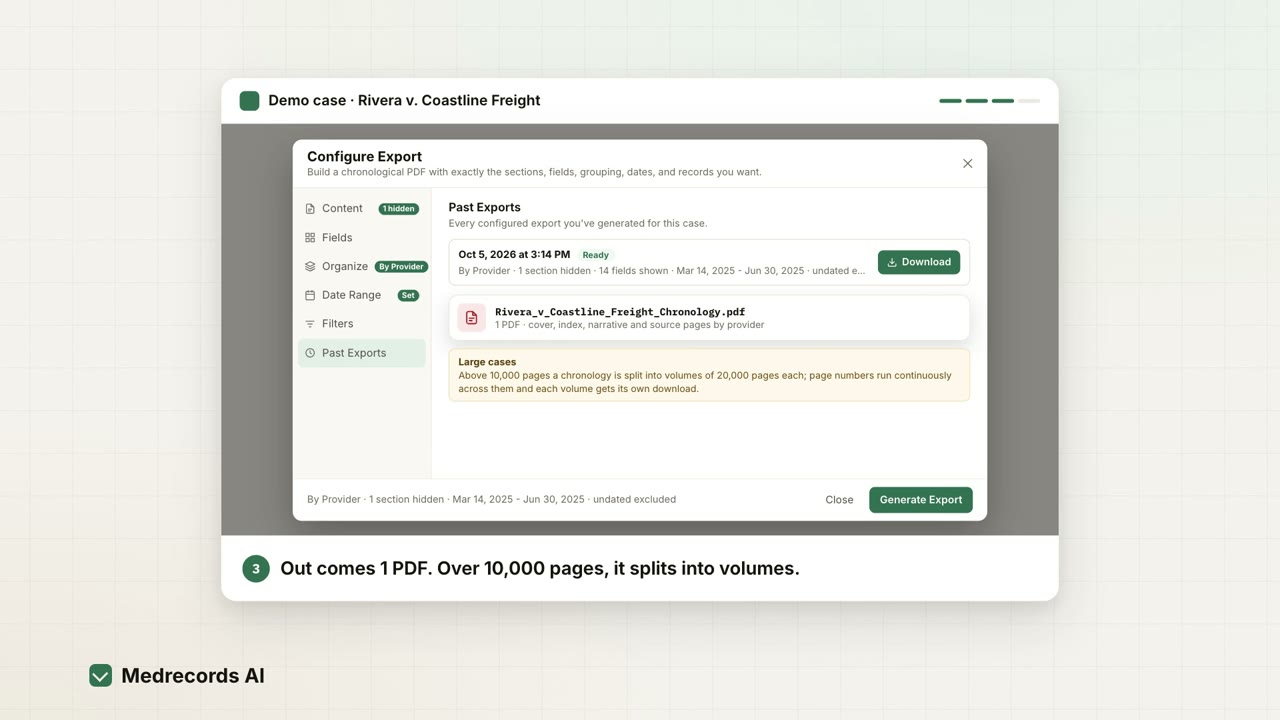
| Work products | Chronology, medical summary, IME report draft, life care plan foundation, expert affidavit and utilization review summary; DOCX, PDF and HTML exports with live source linksOurs, /pricing/ | Clinicians: referral letters, prior auth, patient instructions, deep research reports. Healthcare: discharge summaries, clinical lettersVendor-stated, read 4 Nov 2026 | DependsCase file vs daily clinical writing |
| Admin and deployment | HIPAA-compliant cloud under our BAA, or Enterprise On-Prem inside your network with SAML 2.0 SSO and SCIMOurs, /pricing/ | Healthcare: SAML SSO, SCIM, role-based access, data residency, audit logs and customer-managed encryption keysVendor-stated, read 4 Nov 2026 | DependsOn-prem here; published key control there |
| Model training | Your records never train an AI model; this is contractual in the BAAOurs, /security/ | Clinicians and Healthcare: content not used to train. Health: connected records not used to train foundation modelsVendor-stated, read 4 Nov 2026 | TieBoth state it |
| Who is responsible | You review, revise and sign; every line is editable and opens its source pageOurs, /pricing/ | Clinicians: "You remain responsible for all clinical decisions"Vendor-stated, read 4 Nov 2026 | TieThe clinician signs in both |
| Price | 10 cents a deduplicated page, down to 5 cents at volume; first case freeOurs, /pricing/ | Clinicians: free for verified U.S. clinicians. Health: part of eligible plans. Healthcare: contact salesVendor-stated, read 4 Nov 2026 | ChatGPT for CliniciansFree beats 10 cents a page, if the tool fits the file |
Each cell states the fact and where it came from. "Not published" means we read OpenAI's pages and found no such statement; it does not mean the feature is missing. ChatGPT can analyze text and images in PDFs, and a good prompt can produce a chronology. What OpenAI does not publish is a fixed chart workflow with those guarantees.
Bring us your ugliest caseFirst case is free on us.
We make Medrecords AI, so we are a party to this comparison. Every fact about ChatGPT comes from OpenAI's own pages, and "Not published" means we looked and found no figure. The clinician has the last word.
You need evidence answers and everyday clinical writing. ChatGPT for Clinicians is free, and ChatGPT for Healthcare fits a hospital that wants a single assistant across departments.
You have a long chart to review and sign against. You want duplicates removed, gaps flagged and each entry linked to its page, at a published price per page.
ChatGPT Health itself is the wrong starting point for this work: OpenAI says so. The real comparison for a physician is ChatGPT for Clinicians, and for a hospital it is ChatGPT for Healthcare. You can use both: ChatGPT for literature and Medrecords AI for the chart.
Have a long chart with gaps you worry about? Bring us your ugliest case. First case is free on us.
Summarize this page with ChatGPT, Claude, Perplexity or Google AI
OpenAI ships 3 products on the same models. Health connects your own records from Apple Health (iOS), supported U.S. provider portals, One Medical and Function Health. It can't write back to them, and connected records are deleted within 30 days of disconnecting.
Clinicians verifies you by NPI through a third party, then gives you higher limits, cited answers, reusable skills and CME. Healthcare adds shared templates, integrations such as SharePoint for institutional policy and enterprise controls. On the API, eligible customers apply for a BAA, and teams build their own chart summarization.
You upload the chart: PDFs, scans, handwriting and DICOM, up to 50,000 pages. Medrecords AI removes duplicates, then builds a dated chronology and summaries with each line linked to its source page. It flags missing records and conflicting entries. You review, revise and sign. It does not retrieve records or sign opinions.
For an IME physician, the file ends in a draft IME report. Exports come in DOCX, PDF and HTML with live source links. It costs 10 cents a deduplicated page, down to 5 cents at volume, with a BAA at signup.
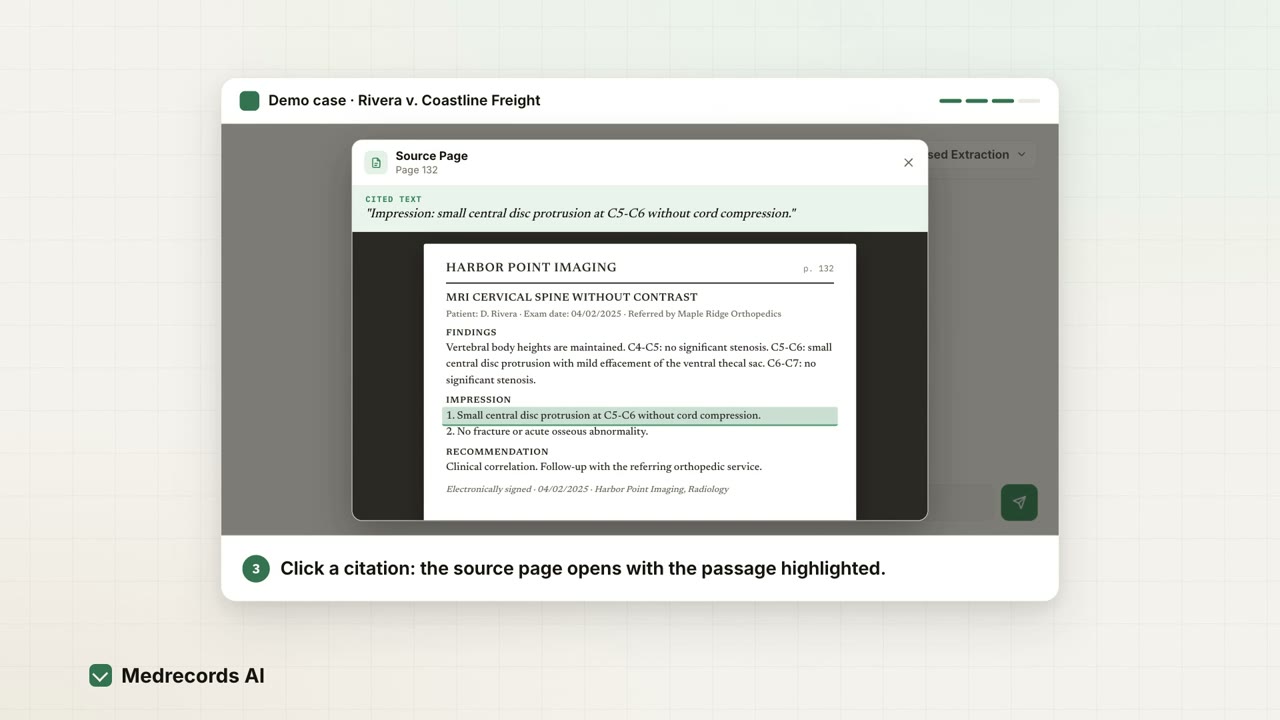
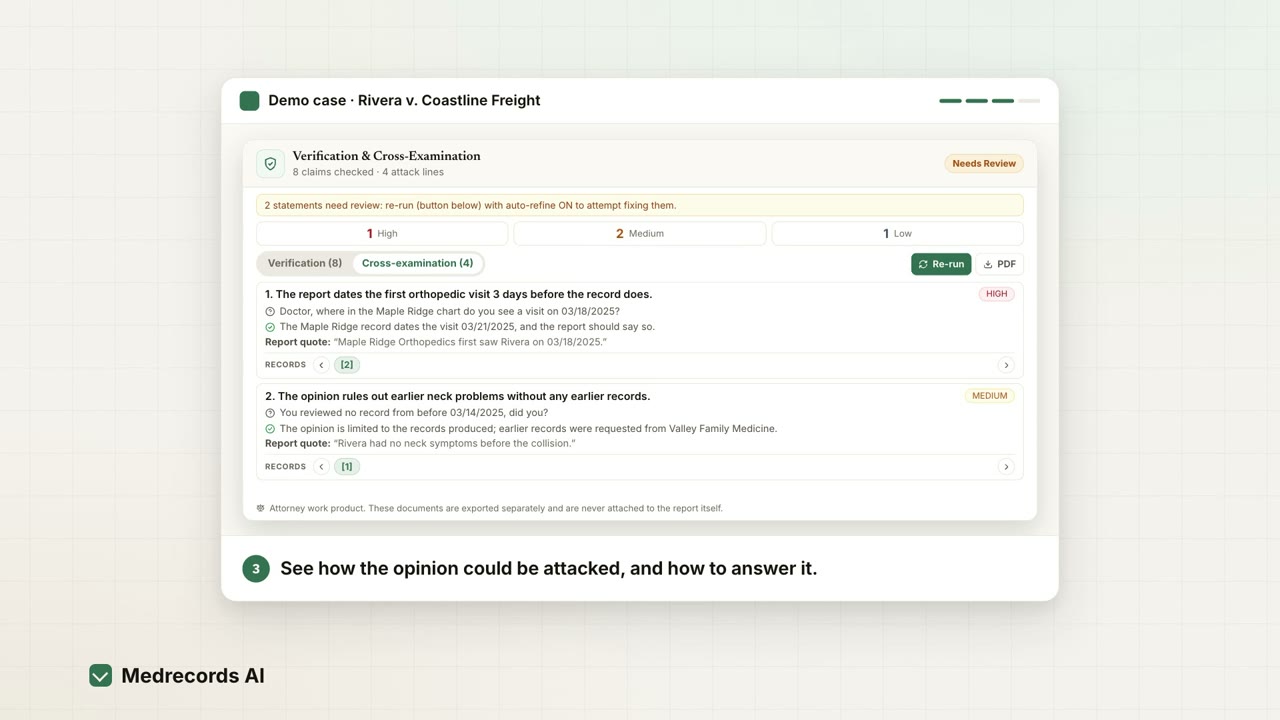
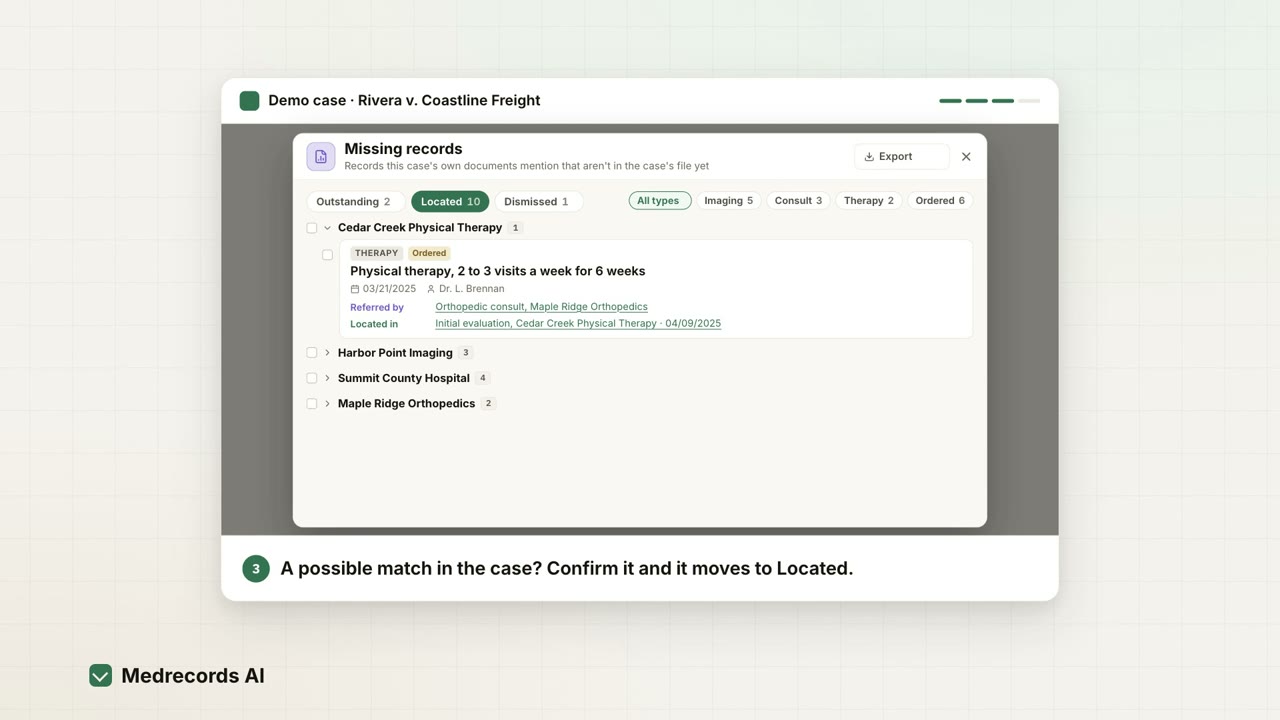
3 short guides from our help center, recorded on a demo case. They play inside the app: sign in or create a free account, and the video opens at the chapter you picked. First case is free on us.
Free account2:35Every medical event on its date, in order, tied to the page it came from. Filter it, search it and export it as PDF or Word.
 Free account2:30
Every record the case documents mention that the file does not contain, grouped by provider, with the page that mentions it.
 Free account2:12
Ask a question in your own words. The answer comes back with numbered links, and each one opens the page it came from.
6 questions a physician or risk manager should ask, answered from what each company publishes.
Its published citations go to medical literature: titles, journals, authors and dates. OpenAI does not publish a page-level link into your uploaded chart. Medrecords AI links every chronology entry and answer to its source page. If you need this, upload a de-identified file on a plan you trust and ask for the page behind 20 facts.
Not to ChatGPT Health: OpenAI says it offers no BAA. On ChatGPT for Clinicians, HIPAA support depends on your being authorized to sign a BAA. On ChatGPT for Healthcare, the BAA is part of the deployment. Medrecords AI signs a BAA at signup. Do not upload PHI without a BAA in place, on any product.
OpenAI caps documents at 512 MB and text and document files at 2 million tokens, and Free users at 3 uploads a day. It states no page limit, and we will not guess at 1. Medrecords AI handles 50,000-page files at about 100 pages a minute and resumes if interrupted.
OpenAI does not publish a deduplication step. Medrecords AI removes duplicates before review and does not bill for them, so 1,000 repeated pages neither clutter the chronology nor cost you anything.
OpenAI does not publish missing-record or contradiction flags. Medrecords AI flags a visit or test mentioned in a note with no record of its own, and entries that disagree on a date or finding. For a standard of care review, an absent record can change the opinion.
You, in both. OpenAI says "You remain responsible for all clinical decisions." Medrecords AI drafts and cites, and you review, revise and sign. It does not sign opinions.
Medrecords AI prices by the deduplicated page, and duplicates are not billed. OpenAI prices ChatGPT by plan or seat, so the 2 only line up once you pick a file.
Medrecords AI bills deduplicated pages on this file. ChatGPT for Clinicians is free for verified U.S. clinicians, so its line shows no per-page price. ChatGPT for Healthcare is contact sales.
| File size | Medrecords AI at 10 cents | Medrecords AI at 5 cents (volume) | ChatGPT for Clinicians |
|---|---|---|---|
| 500 pages | $50 | $25 | Free for verified U.S. clinicians; file limits apply |
| 2,000 pages | $200 | $100 | Free for verified U.S. clinicians; file limits apply |
| 10,000 pages | $1,000 | $500 | Free for verified U.S. clinicians; file limits apply |
OpenAI publishes no price for ChatGPT for Healthcare on its announcement page. Free does not settle the question on a long chart: count your time on duplicates and on finding the page behind each fact.
A summary that reads well can still hide a missing MRI report. Medrecords AI flags missing records and contradictions, so the file shows what is absent as well as what is there.
ChatGPT for Clinicians is broad, and that is its strength. Medrecords AI does not answer general medical questions, write referral letters or award CME. It reads the record and builds the file you review.
Every AI model request at Medrecords AI goes through OpenRouter, mostly to open-source models, with Anthropic and OpenAI as a backup. Those requests run under BAA with zero retention and no training. The list is on our subprocessors page. So do not read this page as a claim that our models beat OpenAI's. The difference on offer is the chart workflow around the model.
What a security or procurement review asks about first, from OpenAI's pages and ours.
| Medrecords AI (ours) | ChatGPT | |
|---|---|---|
| Company | AI Health Studio LLC, doing business as Medrecords AIOurs, /pricing/ | OpenAIVendor-stated, read 4 Nov 2026 |
| Built for | Med mal reviewers, IME physicians, hospital risk management and quality teams, and other teams who work from long chartsOurs, /pricing/ | Health: consumers. Clinicians: individual clinicians. Healthcare: hospitals and health systemsVendor-stated, read 4 Nov 2026 |
| Security stated | SOC 2 and HIPAA; AES-256 at rest, TLS 1.2+ in transitOurs, /pricing/ | Healthcare: SAML SSO, SCIM, role-based access, audit logs, data residency, customer-managed encryption keysVendor-stated, read 4 Nov 2026 |
| BAA | At signup on Self-ServiceOurs, /pricing/ | Health: none. Clinicians: if authorized to sign. Healthcare: available. API: eligible customers applyVendor-stated, read 4 Nov 2026 |
| Named health customers | See our reviews pageOurs, /pricing/ | AdventHealth, Baylor Scott & White, Boston Children's, Cedars-Sinai, HCA, MSK, Stanford Children's and UCSFVendor-stated, read 4 Nov 2026 |
The biggest one, the most duplicated one, or the one with a missing record you found late. Do not clean it up first.
Upload it to ChatGPT for Clinicians or your hospital's ChatGPT and to Medrecords AI. Use a de-identified file on any plan with no BAA. Count duplicate pages removed, gaps flagged and entries with no page link.
Have the person who signs open the source page for every entry and count errors, not impressions. With Medrecords AI, the first case is free on us.
OpenAI says Health in ChatGPT is not intended for clinical or covered-entity use and offers no Business Associate Agreement. For that work it points to ChatGPT for Clinicians and ChatGPT for Healthcare. Treat ChatGPT Health as a tool for your own records.
OpenAI lists summarizing patient charts as a common use and offers HIPAA support if you are authorized to sign a BAA. Sign it before PHI goes in. OpenAI also says you remain responsible for all clinical decisions.
No. This is not a benchmark. We have not run the same records through both tools, so this page makes no accuracy claim about either. It compares what each company publishes, read on 4 Nov 2026.
Yes, as a backup. Every AI model request goes through OpenRouter, mostly to open-source models, with Anthropic and OpenAI as a backup, under BAA with zero retention and no training. The list is on our subprocessors page.
No. It does not answer general medical questions, write prior auth letters or award CME. You can use ChatGPT for literature and Medrecords AI for the chart.
ChatGPT for Clinicians is free for verified U.S. clinicians. ChatGPT for Healthcare is contact sales. Medrecords AI is 10 cents a deduplicated page, down to 5 cents at volume, and your first case is free.
Vendor facts were last read on 4 Nov 2026, and OpenAI changes these pages often. If a figure about ChatGPT is out of date, write to aj@medrecords.ai and we will correct it.
First case is free on us. Upload the chart that hurt last time: duplicates, gaps, handwriting and all. You get a source-linked chronology with missing records and contradictions flagged, and you decide whether it holds up.
Book a demoAccess within 1 business day.
Every figure about OpenAI products is what OpenAI publishes, read on the date shown. Where it does not publish a figure, this page says so and gives no estimate.