Medical record deduplication
3 copies of the same visit. One canonical record.
Medical record deduplication collapses 3 copies of the same visit into one canonical record. Merged provider files carry duplicate entries by default: duplicates are found, confidence-scored, and collapsed by you, without losing a single citation. Collapsed is not destroyed: the duplicates remain reviewable, and every citation survives the collapse back to its source page.
By Ahmed Jemaa, Co-Founder & CEO of Medrecords AI · Published 10 Jul 2026 · Updated 30 Aug 2026Summarize with ChatGPT, Claude, Perplexity or Google AI
From 10 cents a page, down to 5 cents with volume. Billed per page, not per case.
What about near-duplicates: 2 versions of the same page?
Medrecords AI never auto-merges them. A near-duplicate gets flagged with the differing content shown side by side, because a changed word between 2 copies can be an amended record. Suspected alterations route to Record Version & Alteration Detection for a closer look.
Merged files duplicate by default.
A production assembled from the provider, the payer, and prior counsel carries the same visit several times over. Reviewers pay for those pages twice: once in cost, once in attention. Deduplication finds the repeats before anyone reads them.
Confidence-scored, then collapsed, by you.
Exact matches collapse in 1 click. Near-duplicates (a re-fax, an amended note, a different scan of the same page) are flagged with a score and held for a human decision. A changed word between 2 "copies" is exactly what should never disappear silently.
Citations survive the collapse.
The canonical page inherits the provenance of every copy: which packet it arrived in, where it sat, and its Bates range. Any citation that pointed at a duplicate resolves to the canonical page, so nothing in a chronology or report breaks.
Collapsed is not destroyed.
Every collapse is a logged event: who confirmed it, when, and exactly what was hidden. The duplicate pages stay in the file, recoverable, with the audit trail to prove the record wasn't altered. Source-linked and legally defensible, even after cleanup.
See Record Version & Alteration DetectionFrom merged mess to canonical file.
Deduplication runs at intake, so everything downstream reads the clean record.
Provider files, payer files, and prior productions go in together: duplication expected.
Exact copies are grouped automatically; near-duplicates get a confidence score and wait for a human.
1 click per set. The canonical page keeps every copy's provenance, and the collapse is logged.
Watch duplicate pages removed, each with its reason
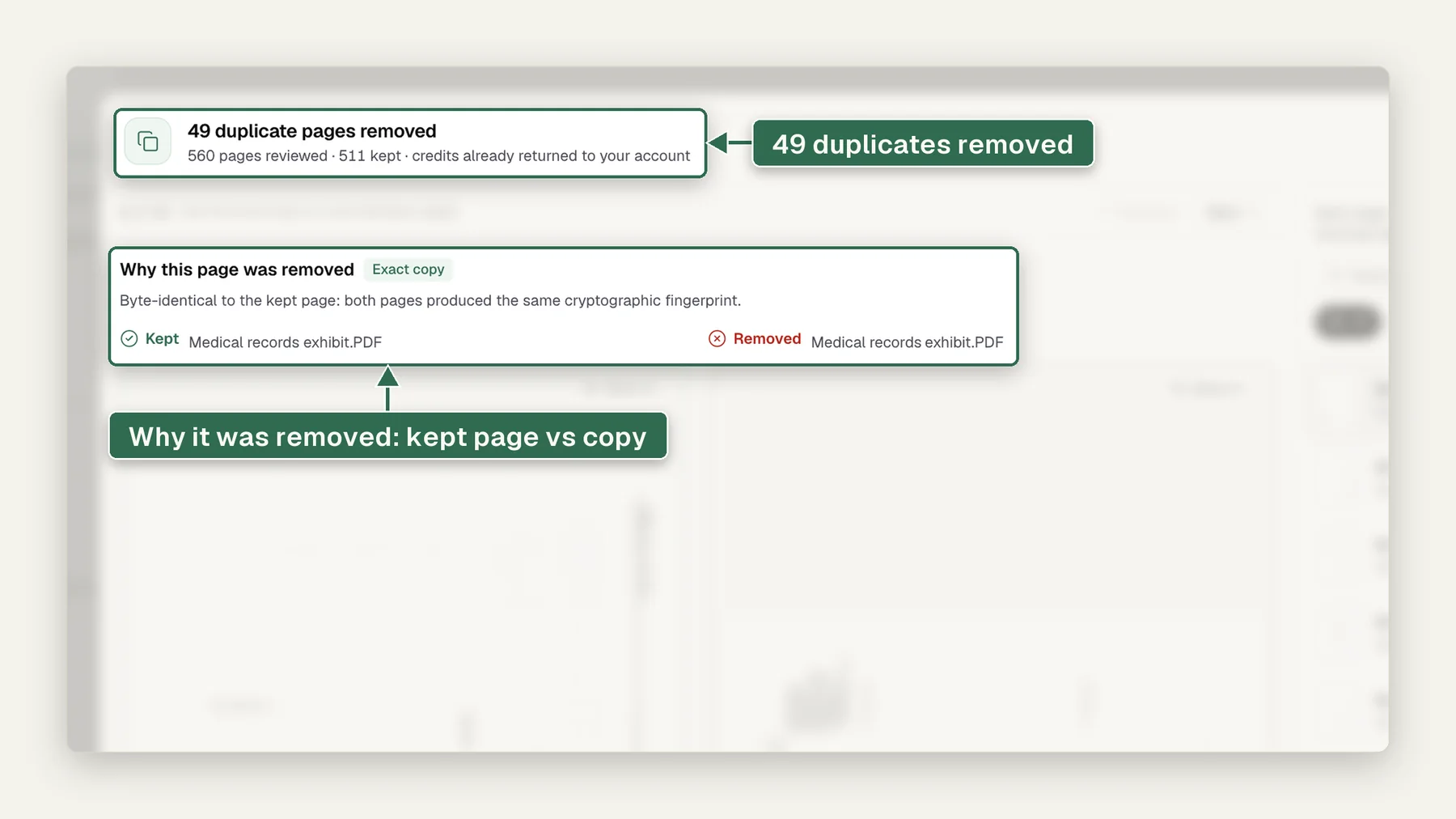
The demo starts on the Create New Case form of a demo case, where Strip cover pages, Strip custodian certifications and Remove duplicate pages are all on by default. The cover page tooltip notes that stripped pages stay in the stored records and keep their page and Bates numbers. After processing, the Uploaded Files panel shows a banner for each kind of page set aside: 42 duplicate pages removed, 7 images set aside as non-clinical, 9 cover pages stripped and 4 blank pages removed. View on the duplicates banner lists each kept page next to the copies removed from it, with a match type of Exact, Subset or AI and a short reason. Compare opens both pages side by side, highlights the shared lines and states why the copy was removed. Every name, provider and date in the demo is invented.
Transcript
- Covers, certifications and duplicates are stripped at upload by default.
- The case page counts what was set aside, and why.
- Each removed page sits next to the page that was kept.
- Compare any pair side by side, with the reason it was removed.
Watch it as a video page · Download the video (MP4, 20 seconds)
Who dedupes with it.
Anyone who pays for pages twice, in review cost or reviewer attention.
Where it stops
- It collapses exact copies on your say-so; it never auto-merges near-duplicates, which wait for a human decision.
- It reads only the files you upload. It does not request or retrieve records for you.
- It drafts and cites. It does not diagnose, give a medical opinion or sign anything; a qualified reviewer checks the output.
- Each finding cites its source page, so the reviewer can check it against the record.
More questions, answered
How are wrong-patient pages detected?
Every page is checked against the case patient on 2 axes: identity signals (name, date of birth, record identifiers) and clinical continuity, meaning whether the page's content is consistent with the rest of the file. A left-shoulder operative note inside a right-knee case gets flagged even if no name appears on the page.
What happens when a page is quarantined?
It is pulled out of the analysis pipeline immediately: excluded from the chronology, search, chat, reports, and any export or production. Reviewers see that a page was quarantined and the stated reason, but the content is held back so the other patient's PHI stops spreading.
How does this prevent a PHI incident?
A co-mingled page that reaches a report, a production, or opposing counsel is a disclosure, with the notification duties that follow. Detection at intake means the page never reaches a downstream output, so what would have been an incident becomes a documented catch.
Can a quarantined page ever reach analysis?
Only by an explicit human decision. If a reviewer determines the page does belong to the case patient (a maiden name, a transcription error), they can release it, and the release is logged with the reviewer and reason. Nothing is released automatically.
What audit trail exists behind a quarantine?
Every step writes an entry: detection, the stated mismatch, the quarantine, and the eventual release or removal, each with a timestamp and actor. The log exports with the case, so compliance gets evidence rather than recollection.
Deduplication, answered.
Pages are compared across the whole production, across packets. Exact copies match even when scan quality differs; near-matches get a confidence score that reflects how much of the page is identical. High-confidence sets collapse in 1 click, and anything ambiguous is held for review.
Yes. That is the core case. A file merged from the provider, the payer, and prior counsel typically repeats the same visits; in a representative 342-page, 2-packet production, 11 duplicate pages were found and collapsed to one canonical record.
Yes. The canonical page inherits every copy's provenance: source packet, position, and Bates range. Citations that pointed to a collapsed copy resolve to the canonical page, so chronologies, reports, and exports keep working.
They are never auto-merged. A near-duplicate gets flagged with the differing content shown side by side, because a changed word between 2 copies can be an amended record. Suspected alterations route to Record Version & Alteration Detection for a closer look.
Both. Confirmed exact sets can be collapsed one at a time or all at once, and every collapse (single or bulk) is logged with the reviewer, timestamp, and affected pages, and can be reversed.
Related capabilities
Adjacent features on the same platform: every output source-linked and cited to page.
Pages from the wrong patient flagged and quarantined before analysis.
ExploreNew batches arrive pre-deduplicated and flagged where they agree, conflict, or add.
ExploreNear-duplicates that differ get scrutiny, not a silent merge.
ExploreNumbering that holds through sorting, dedup, and production.
ExploreRelated features
Deduplication is 1 pass in a larger intake cleanup: these run alongside it.
Logos, blank scan backs, and cover art are excluded automatically, before duplicate matching even starts.
ExploreLaw-firm cover sheets and custodian certifications are removed from the working set: paperwork, not a duplicate, but the same kind of noise.
ExploreCase details are pulled from the upload the moment it lands: the same intake pass deduplication runs in.
ExploreFind out how much of your file is repeats.
Upload one merged production and see the duplicate sets, scored and cited. Handled under our BAA; never used to train a model.