Content Hub guides › Maximum medical improvement
Maximum medical improvement (MMI): a physician's guide, state by state
Maximum medical improvement (MMI) is the point where further material recovery is no longer reasonably expected. The physician reviews the records, examines the patient for that purpose and sets 1 MMI date, then rates any permanent impairment as of that date with the guide the state requires. In Texas, a wrong date or edition invalidates the rating.
- ›MMI means stable, not healed or pain free. Minnesota judges it "regardless of subjective complaints", and California calls the same point permanent and stationary.
- ›In Texas only an authorized doctor may certify MMI and assign a rating. A certifying doctor is a different DWC credential from a designated doctor.
- ›The rating guide depends on the state. California, Georgia and Ohio use the AMA Guides 5th Edition, Texas the 4th, Pennsylvania and federal employees' comp the 6th, and Florida, New York and North Carolina their own guides.
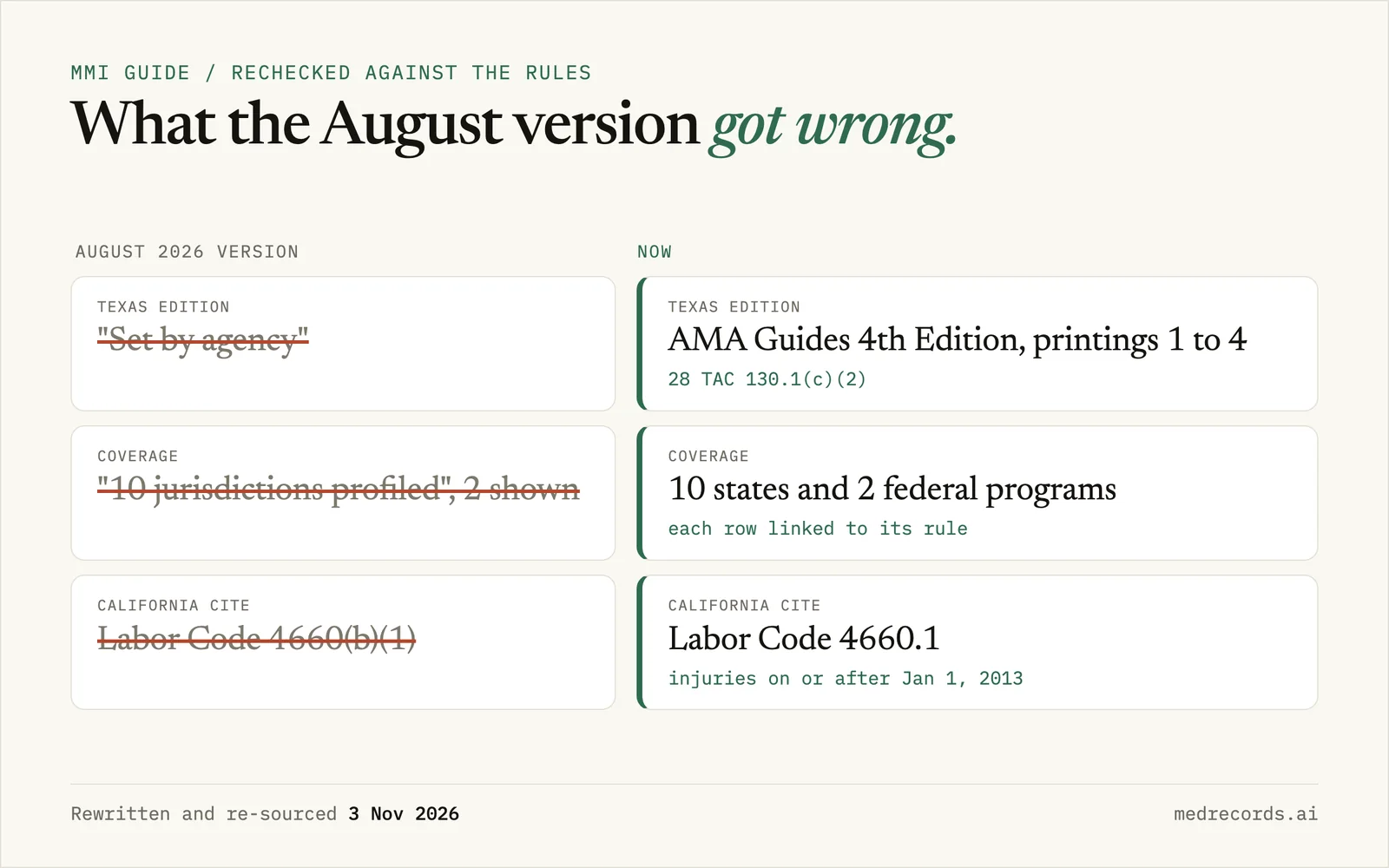
- ›Texas plans to move to the AMA Guides 6th Edition (2025). DWC's tentative timeline targets exams on or after January 1, 2028; no rule had been adopted as of 2026-11-03.
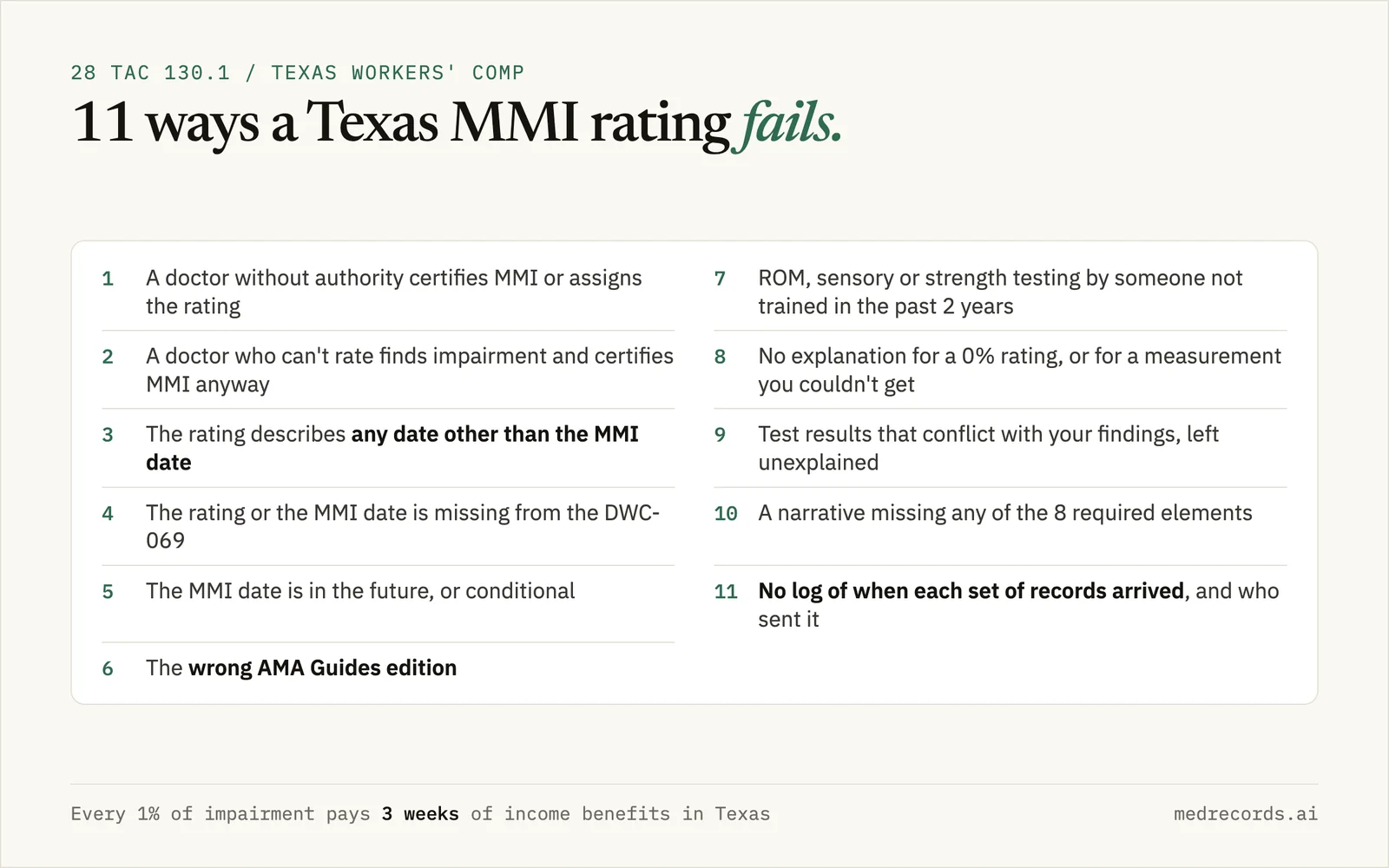
- ›Texas lists 11 ways an MMI certification or rating fails, from a prospective date to a missing narrative element. Most come down to the prior record: what arrived, when, from whom, and whether the report explains it.
What counts as maximum medical improvement?
MMI is the earliest date after which lasting improvement to an injury can no longer reasonably be expected. It describes where recovery is heading, not how the patient feels: a patient at MMI can still have pain, take medication and need care.
The wording differs by jurisdiction, but the idea is the same.
| Jurisdiction | Term used | Working definition | Rule |
|---|---|---|---|
| Texas | MMI | "the earliest date after which, based on reasonable medical probability, further material recovery from or lasting improvement to an injury can no longer reasonably be anticipated", or 104 weeks after income benefits begin to accrue, or a date extended for spinal surgery | 28 TAC 130.1(b)(1) |
| California | Permanent and stationary | "well stabilized, and unlikely to change substantially in the next year" | 8 CCR 9785(a)(8) |
| Federal employees (FECA) | Date of MMI | The impairment "has reached a permanent and fixed state", with the date it did | FECA PM 2-0808 |
| Minnesota | MMI | Judged "regardless of subjective complaints" | Minn. Stat. 176.011 subd. 25 |
California's wording matches the AMA Guides framing, which Medscape's impairment rating review gives as impairment that is "well stabilized and unlikely to change substantially in the next year". Texas adds 2 calendar routes, so a Texas patient can reach MMI by statute even when the clinical course has not settled.
Who can certify MMI and assign the impairment rating?
In Texas, only a doctor DWC has authorized. In California, the primary treating physician usually makes the first finding. Under the federal employees' program, the physician supplies the evidence and the program decides the award.
Texas. Only an authorized doctor may certify MMI, decide whether permanent impairment exists and assign a rating (28 TAC 130.1(a)(1)). 3 roles qualify:
- the treating doctor, or a doctor the treating doctor refers the patient to in its place;
- a designated doctor (DD) appointed by DWC;
- a carrier-selected required medical examination (RME) doctor, approved by DWC after a designated doctor exam.
A doctor DWC has not certified to rate may certify MMI only when the patient has no permanent impairment. If that doctor finds impairment, the patient goes to an authorized doctor. A certification or rating by an unauthorized doctor is invalid and is not reimbursed (130.1(a)(2)).
California. In practice the primary treating physician makes the first permanent and stationary finding, and a qualified medical evaluator (QME) or agreed medical evaluator (AME) addresses it if a party disputes it. That description comes from a law firm page; the rule text we checked is 8 CCR 9785, which requires the primary treating physician to "incorporate, or comment upon" the findings of each secondary physician's report within 20 days of receiving it.
Federal employees (FECA). The file needs medical evidence of the MMI date, a description detailed enough for the claims examiner to "visualize" the impairment, and a percentage (FECA PM 2-0808). The Office of Workers' Compensation Programs (OWCP) then decides the schedule award.
Which AMA Guides edition does my state require?
It depends on the state, and 3 of the 10 most populous states do not use the AMA Guides at all. California, Georgia and Ohio use the 5th Edition, Texas the 4th and Pennsylvania the 6th, while Florida, New York and North Carolina rate with their own guides.
| State or program | Rating basis | Rule |
|---|---|---|
| California | AMA Guides 5th Edition, whole person impairment x 1.4 (injuries on or after January 1, 2013) | Labor Code 4660.1 |
| Texas | AMA Guides 4th Edition (1st to 4th printings); 6th Edition (2025) planned, tentatively for exams on or after January 1, 2028 | 28 TAC 130.1(c)(2) |
| Florida | 1996 Florida Uniform Permanent Impairment Rating Schedule | Fla. Admin. Code 69L-7.604 |
| New York | 2018 New York WCB Impairment Guidelines | NY WCB guidelines |
| Pennsylvania | AMA Guides 6th Edition, 2nd printing April 2009; impairment rating evaluation threshold 35% | Act 111 of 2018, 77 P.S. 511.3 |
| Illinois | "Most current edition" of the AMA Guides, 1 of 5 factors in permanent partial disability | 820 ILCS 305/8.1b |
| Ohio | AMA Guides 5th Edition for most specialties; 4th Edition for ophthalmology | Ohio IC Medical Examination Manual |
| Georgia | AMA Guides 5th Edition | O.C.G.A. 34-9-263(d) |
| North Carolina | NC Industrial Commission Rating Guide | NC IC Rating Guide |
| Michigan | Wage-loss system with no impairment rating step (secondary source) | MCL 418.361, via AAEME |
| FECA (federal) | AMA Guides 6th Edition for ratings on and after May 1, 2009 | 20 CFR 10.404; FECA PM 2-0808 |
| Longshore (federal) | AMA guides named for hearing loss | 33 U.S.C. 908(c)(13)(E) |
10 most populous states plus 2 federal programs, verified 2026-11-03. The Michigan row rests on a secondary source. Whether North Carolina raters also use the AMA Guides alongside the state guide is unconfirmed, and which edition Illinois treats as "most current" in practice is not stated in the statute.
2 warnings. First, Texas is on the 4th Edition today for exams on or after October 15, 2001, and a rating made with the wrong edition "shall not be considered valid". Second, a rater who moves between Florida, New York and an AMA state is switching rating systems, not editions. For what changed between editions, see AMA Guides editions explained.
How does MMI work in Texas?
An authorized doctor certifies MMI on DWC Form-069 with a narrative, rates with the AMA Guides 4th Edition and files by the 7th working day. Statutory MMI applies at 104 weeks, and the rating sets the weeks of impairment income benefits. State pages: Texas and California.
Certifying doctor or designated doctor: which do you need?
TDI puts it plainly: "A certifying doctor is not the same as a designated doctor."
- Certifying doctor (MMI/IR). Pass DWC's certification test once (no retest if you passed on or after May 13, 2013) and complete online training every 2 years. TDI says pay for MMI and impairment rating exams "has increased about 28%" as of June 2024, with yearly updates by the Medicare Economic Index. An MMI-only exam that finds no impairment does not require the treating doctor to hold this certification.
- Designated doctor. A separate DWC appointment for disputes. DDs renew by completing required training and reapplying every 2 years. Official Disability Guidelines (ODG) return-to-work guidance applies to return-to-work determinations on or after October 1, 2026, and DDs must take that training. The DD's report has presumptive weight (Labor Code 408.1225(c)).
Certify first, then rate, and order the tests you need
The rule fixes the order. "MMI must be certified before an impairment rating is assigned", and the rating must describe the patient's condition on the MMI date; a rating based on any other date is invalid (130.1(b)(2)). The MMI date and the rating also have to appear together on the Report of Medical Evaluation.
If you need more data to rate, the referral is yours. The certifying doctor is "responsible for referring" the patient to another doctor or provider for testing or evaluation, then must document the results, incorporate them into the rating and acknowledge them in the report. When a result does not fit your clinical findings, the report has to explain why you did not use it (130.1(c)(3)(F)).
Statutory MMI at 104 weeks, and the spinal surgery extension
If clinical MMI has not come first, MMI is reached at "the expiration of 104 weeks from the date on which income benefits begin to accrue" (130.1(b)(1)(B)). Count from that date, not from the injury date.
On application, DWC may extend the 104 weeks if the employee had spinal surgery, or was approved for it, within 12 weeks before the period expires. The order extends MMI "to a date certain, based on medical evidence" (Labor Code 408.104).
DWC-069 and the 7th working day
Each certification needs a signed Report of Medical Evaluation (DWC Form-069) and a narrative. File both with DWC, the patient, the patient's representative and the carrier no later than the 7th working day after the later of the exam date or receipt of all the medical information the rule requires (130.1(d)(2)).
For a designated doctor exam, the treating doctor and the carrier must send all medical records at least 3 working days before the appointment, and late records can force a reschedule (DWC quarterly meeting slides, October 14, 2026). For how the same records are read at every stage of a comp claim, see our workers comp medical record review guide.
What you can bill (28 TAC 134.260)
Referred doctors bill MMI and impairment rating exams under CPT 99456 with the matching modifier. The rule sets these base amounts:
| Service | Base amount |
|---|---|
| MMI evaluation | $449 |
| Impairment rating, first musculoskeletal body area | $385 |
| Each additional musculoskeletal area, up to 3 in total | $192 |
| Non-musculoskeletal areas | Billed per area examined |
Each base amount is "adjusted per §134.210(b)(4)", so the current payment is higher than the table. If the patient is not at MMI, bill only the MMI portion and add modifier "NM". The fee covers the exam, the records and film review and the report, including "responding to the need for further clarification", so answering a carrier or DWC question about the report is not a separate bill. Only an authorized doctor may bill and be paid for the exam.
The planned move to the AMA Guides 6th Edition (2025)
DWC "plans to transition" to the 6th Edition (2025) after "over 20 years" on the 4th. Comments on the informal draft rule closed at 5 p.m. Central on August 13, 2026, the day after a stakeholder meeting. DWC's tentative timeline targets exams on or after January 1, 2028, after rulemaking in July to December 2026 and at least a year of doctor training and testing. The slides say the dates are "tentative and subject to change". Until DWC adopts a rule, rate Texas exams with the 4th Edition. The edition change does not touch the benefit formula: income benefit calculations are set by Labor Code 408.121, which DWC says it cannot change through rulemaking.
What the rating pays: impairment income benefits
Texas pays 3 weeks of impairment income benefits (IIBs) for each 1% of impairment, so a 10% rating pays 30 weeks, at 70% of the average weekly wage, starting the day after MMI. Every point you assign is 3 weeks of benefits, which is why carriers and attorneys read the narrative behind it.
How do federal claims handle MMI and ratings?
Federal employees' claims use the AMA Guides 6th Edition for ratings calculated on and after May 1, 2009 (FECA PM 2-0808). The regulation, 20 CFR 10.404, defers to "the specified (by OWCP) edition", so OWCP can change editions without amending the rule. A schedule award needs evidence of the MMI date, a description detailed enough to visualize the impairment, and a percentage based on a specific diagnosis rather than the body as a whole, except for the lungs.
The Longshore Act names the AMA guides only for hearing loss (33 U.S.C. 908(c)(13)(E)). We found no Longshore text that defines MMI, so check case law before relying on one.
What changes for my patient once I certify MMI?
Certifying MMI usually ends the temporary phase of a claim and starts the permanent one: the rating, permanent benefits and often settlement talks. Medical care does not always stop.
| Jurisdiction | What changes at MMI | Source |
|---|---|---|
| Texas | Impairment income benefits can start the day after MMI: 3 weeks per 1%, at 70% of the average weekly wage | TDI |
| Texas | Temporary income benefits end | Law firm page |
| Minnesota | Benefits can stop 90 days after the insurer serves a written MMI report | Minnesota DLI |
| California | Medical care continues after MMI unless the claim settles | Law firm page |
| FECA | A schedule award needs the MMI date and a percentage | DOL PM 2-0808 |
How long patients take to get there, from NCCI's September 2024 study of impairment ratings (accident years 2017 to 2022):
- The average whole-body rating was 6.5%, and the average time to MMI on permanent partial claims was 363 days. 90% of cases reached MMI within 2 years.
- Median time to MMI ran from 189 to 644 days across states, and median ratings from 2% to 9%.
- Claims that reached MMI in under 90 days averaged a 4.4% rating; claims over 2 years averaged 9.1%. Claims with surgery averaged 7.2%, against 5% without.
- A 1% change in the average rating meant about $2,500 in permanent partial disability costs, about 8% of indemnity on those claims.
NCCI's data excludes California, Texas, New York, Pennsylvania, Ohio and Michigan. Of the states in the edition table above, it covers only Florida, Georgia, Illinois and North Carolina.
What happens when another examiner disagrees?
The dispute path depends on the state. In Texas, the designated doctor's report carries presumptive weight; in California, a QME or AME addresses a disputed finding.
- Texas. DWC follows the designated doctor's report "unless the preponderance of the other medical evidence is to the contrary" (Labor Code 408.1225(c)). A carrier's RME doctor may rate only after a designated doctor exam, with DWC approval.
- California. An unrepresented worker cannot use an agreed medical evaluator (AME). Either side can request a panel of 3 QMEs, and the worker picks 1 within 10 days (Labor Code 4062.1). For a represented worker, each side strikes 1 name from a 3-member panel and the remaining QME does the evaluation, or the parties agree on an AME at any time (Labor Code 4062.2).
Disputes often turn on method rather than medicine. Medscape's impairment rating review cites older studies, without dates, in which 25% of repeat Texas ratings for the same condition differed by more than 10%, and 65% of Texas disputes were about rating methodology.
What gets an MMI rating thrown out?
Texas spells out 11 ways a certification or rating fails under 28 TAC 130.1. Other states have their own rules, but reviewers everywhere look for the same gaps.
- An unauthorized doctor certifies MMI or assigns a rating: invalid and not reimbursed ((a)(2)).
- A doctor without rating authority finds impairment but certifies MMI anyway ((a)(2)).
- The rating describes the patient's condition on a date other than the MMI date ((b)(2), (c)(3)).
- The rating or the MMI date is missing from the Report of Medical Evaluation ((b)(2)).
- The MMI date is prospective or conditional ((b)(4)(C)(i)).
- The wrong AMA Guides edition: "shall not be considered valid" ((c)(2)(C)).
- Range of motion, sensory or strength testing was done by someone without the required rating training in the prior 2 years: the rating is invalid and any payment must be refunded ((c)(4), (c)(5)).
- No explanation of the findings behind a 0% rating, or of measurements the doctor could not obtain ((c)(3)(D)).
- Additional test results that conflict with the doctor's findings are not explained or acknowledged ((c)(3)(F)).
- The narrative is missing any of the 8 required elements ((d)(1)(B)).
- No record of when each set of medical records arrived and who sent it ((e)(2)).
Medscape adds 3 reporting habits that keep a rating reviewable anywhere: cite the AMA tables and figures used, state "which impairments were added and which were combined", and state the apportionment between the injury and unrelated conditions.
What should an MMI report include?
A report that survives review shows who certified, which records were read, the exam, 1 specific date, the edition and the arithmetic. The checklist below follows the Texas rule because it is the most explicit; the California and Medscape items apply more widely.
| # | Step | What to document | Rule |
|---|---|---|---|
| 1 | Confirm you can certify | Certifying doctor status, or MMI-only with no impairment | 28 TAC 130.1(a) |
| 2 | Collect the prior record | The date each set of records arrived and who sent it | 130.1(e)(2) |
| 3 | Reconcile outside reports | Incorporate or comment on each specialist report (California: within 20 days) | 8 CCR 9785(e)(4) |
| 4 | Examine for MMI | An exam done for the explicit purpose of determining MMI | 130.1(b)(4)(B) |
| 5 | Set the date | 1 specific date, not prospective or conditional; may be retrospective to the exam | 130.1(b)(4)(C) |
| 6 | Check statutory MMI | 104 weeks from accrual of income benefits; spinal surgery extension | 130.1(b)(1)(B); Labor Code 408.104 |
| 7 | Use the required edition | Edition named in the report | 130.1(c)(2), (d)(1)(B)(vii) |
| 8 | Rate as of the MMI date | 1 whole body rating for the compensable injury | 130.1(c)(3)(E) |
| 9 | Show the work | Findings per impairment, including 0%; missing measurements explained; tables and figures cited; added vs combined; apportionment | 130.1(c)(3)(D); Medscape |
| 10 | Check who did the testing | Range of motion, sensory and strength testing by a practitioner trained within 2 years | 130.1(c)(4) |
| 11 | Explain conflicts | Why inconsistent outside data was not used | 130.1(c)(3)(F) |
| 12 | Sign and file | DWC-069 plus narrative by the 7th working day | 130.1(d) |
| 13 | Bill | CPT 99456 with modifier; "NM" if not at MMI | 28 TAC 134.260 |
The Texas narrative must include 8 elements (130.1(d)(1)(B)): the exam date; the MMI date; normal and abnormal findings with the analysis of whether MMI was reached; a history linking the injury to the treatment; current clinical status; the diagnosis and clinical findings of permanent impairment; the AMA Guides edition used; and a copy of any DWC authorization by exception. For report structure beyond MMI, see how to write an IME report.
How do I check the prior record before setting the MMI date?
Read the full prior record before the certifying exam, log what arrived and when, and resolve every outside finding that conflicts with yours in the report. 2 of the 11 Texas failure points above, the missing arrival log and the unexplained outside result, are record problems, not exam problems.
On 2026-11-03 we read the top Google results for "maximum medical improvement" and 3 related searches. Every result outside TDI's pages was written for injured workers or their attorneys, and none told the physician how to handle the prior record. The checks below are our method, built from the rules above.
| Check | What passes | Where the proof is |
|---|---|---|
| Arrival log | Each set of records has a received date and a sender | Your intake log, fax and portal stamps |
| Designated doctor packet | Records in hand at least 3 working days before the exam | Carrier and treating doctor transmittals |
| Outside reports | Each specialist or secondary report is incorporated or commented on | Consult notes, prior IMEs, QME reports |
| Prior ratings | Any earlier rating is named, with its edition and date | Prior DWC-069s, prior IME reports |
| Surgeries and procedures | Every surgery is dated, and any pending one is addressed | Op notes, surgical scheduling, 408.104 orders |
| Conflicting data | Each test result that disagrees with your exam is explained | FCE reports, outside ROM tests, imaging |
| Unrelated conditions | Pre-existing and unrelated findings are separated for apportionment | Older records for the same body part |
Here is how a failed row looks. This is an illustration we wrote, not a patient and not a Medrecords output. A Texas treating doctor examines a lumbar strain patient and certifies MMI with a 5% rating. The packet that arrived after the referral includes a second surgeon's note, dated 2 weeks before the exam, approving a lumbar fusion. The narrative never mentions it. That is unexplained additional information under (c)(3)(F), and the pending surgery may support a 408.104 extension. A narrative that names the note, its date and its page, and explains why the date still stands or why it moved, closes the gap.
Medrecords AI builds a cited chronology of the prior record before the exam, so each prior finding, surgery and outside rating sits on 1 timeline with its source page, and missing-records detection flags a referenced report that never arrived. For IME and QME work it also drafts the report from your notes, with those citations in place.
What it does not do: examine the patient, certify MMI, assign the rating, choose the edition or file DWC-069. Those stay with you. Pricing is 10¢ per deduplicated page, down to 5¢ at volume, with duplicates never billed and no subscription.
The short answer
MMI is the date recovery stops being expected to improve in a lasting way. You set it after a records review and an exam done for that purpose, then rate any permanent impairment as of that date with the guide your state requires.
- Texas: only an authorized doctor certifies; use the 4th Edition until DWC adopts the 6th; file DWC-069 and the narrative by the 7th working day; bill CPT 99456 with "NM" if not at MMI.
- California: permanent and stationary means "well stabilized"; rate with the 5th Edition x 1.4 and address every secondary report within 20 days.
- Federal employees: 6th Edition since May 1, 2009; give the date, a detailed description and a diagnosis-based percentage.
- Everywhere: log when the prior records arrived and who sent them, and explain every outside finding that disagrees with yours.
AI does the reading and helps you make the call. The last word is yours. Book a demo. First case is free on us. Or see pricing.
Bring us your ugliest case. In a live demo we build the cited chronology for the packet behind your next MMI exam, and you check any row against its page. First case is free on us.
Frequently asked questions
Can a patient be at MMI and still have pain?
Yes. Minnesota judges MMI "regardless of subjective complaints", and other states apply the same idea: MMI means the condition is stable, not resolved. The rating then measures the permanent impairment that remains, and Texas requires it to rest on objective clinical or laboratory findings (28 TAC 130.1(c)(3)(A)).
Can the MMI date be in the past?
In Texas, yes, back to the date of the certifying exam. It cannot be a future or conditional date (28 TAC 130.1(b)(4)(C)). Statutory MMI at 104 weeks can also fall before your exam, so check when income benefits began to accrue before you pick a date.
Is a 0% impairment rating valid?
Yes. Texas says "a zero percent impairment may be a valid rating" (28 TAC 130.1(c)(1)). The report still has to describe and explain the clinical findings behind it, the same as any other rating (130.1(c)(3)(D)).
How long does it take to reach MMI?
NCCI's September 2024 study puts the average at 363 days for permanent partial claims, with 90% of cases at MMI within 2 years and state medians from 189 to 644 days. In Texas, statutory MMI applies at 104 weeks after income benefits begin to accrue unless DWC extends it for spinal surgery.
Do I need to be a designated doctor to certify MMI in Texas?
No. The certifying doctor credential is separate from the designated doctor role. A treating doctor's MMI-only exam that finds no impairment does not need either, but assigning an impairment rating requires DWC authorization as a certifying doctor or one of the other authorized roles.
Does Medrecords AI certify MMI or assign ratings?
No. Medrecords AI reads the prior record, builds a page-cited chronology, flags missing records and drafts IME and QME report sections with citations. The physician examines the patient, sets the MMI date, assigns the rating and signs. The software is SOC 2 and HIPAA compliant, with a BAA at signup.
Sources
Vendor prices and features below come from public pages captured on the dates shown. Vendors change pricing often, so confirm before you buy.
- 28 Tex. Admin. Code 130.1, certification of MMI and evaluation of permanent impairment (captured 2026-11-03)
- 28 Tex. Admin. Code 134.260, MMI and impairment rating examinations by referred doctors (captured 2026-11-03)
- Texas Labor Code 408.104, MMI after spinal surgery (captured 2026-11-03)
- Texas Labor Code 408.1225, designated doctor (captured 2026-11-03)
- TDI DWC: certifying doctors (MMI/IR) (captured 2026-11-03)
- TDI DWC: designated doctors (captured 2026-11-03)
- TDI DWC: quarterly meeting slides, October 14, 2026 (PDF) (captured 2026-11-03)
- TDI DWC: AMA Guides 6th Edition transition (captured 2026-11-03)
- TDI DWC: AMA Guides stakeholder meeting slides, August 12, 2026 (PDF) (captured 2026-11-03)
- TDI DWC: impairment income benefits (captured 2026-11-03)
- 8 CCR 9785, reporting duties of the primary treating physician (captured 2026-11-03)
- California Labor Code 4660.1 (captured 2026-11-03)
- California Labor Code 4062.1 and 4062.2 (captured 2026-11-03)
- Minnesota DLI: maximum medical improvement (captured 2026-11-03)
- US DOL OWCP: FECA Procedure Manual 2-0808, schedule awards (captured 2026-11-03)
- 20 CFR 10.404 (captured 2026-11-03)
- 33 U.S.C. 908, compensation for disability (captured 2026-11-03)
- Fla. Admin. Code 69L-7.604 (captured 2026-11-03)
- New York WCB: impairment guidelines (captured 2026-11-03)
- Pennsylvania Bulletin vol. 55 no. 4, impairment rating evaluations (PDF) (captured 2026-11-03)
- 820 ILCS 305/8.1b (captured 2026-11-03)
- Ohio Industrial Commission: medical examination manual (PDF) (captured 2026-11-03)
- O.C.G.A. 34-9-263 (Justia) (captured 2026-11-03)
- NC Industrial Commission: rating guide (captured 2026-11-03)
- AAEME: AMA Guides by jurisdiction (captured 2026-11-03)
- NCCI: impairment ratings in workers compensation, September 2024 (captured 2026-11-03)
- Medscape: impairment rating and disability determination (captured 2026-11-03)
- WorkersComp.com: maximum medical improvement in Texas (captured 2026-11-03)
- Employees First Labor Law: MMI in California workers comp (captured 2026-11-03)
- Medrecords AI pricing (as of 2026-11-03)