Guides › Functional capacity evaluation For what else SSA counts as evidence and how far back it looks, see our SSDI medical evidence.
Functional capacity evaluation (FCE): what it tests, costs and proves
A functional capacity evaluation (FCE) is a set of standardized tests, run by a licensed physical or occupational therapist, that measures what a person can physically do against the demands of a job. Most take about 4 hours and some run over 2 days. The report guides work restrictions; it does not decide disability on its own.
- ›An FCE tests lifting, carrying, positional tolerance, endurance and effort. Washington L&I requires 6 elements in a standard FCE, from worker history to psychosocial questionnaires.
- ›Length runs from about 2 hours to 2 days. Johns Hopkins says most take 4 hours; MedStar runs 6 to 8 hours over 2 days.
- ›Published prices run $660 to $916 on MDsave, and New York's vocational rehab program pays $136 an hour up to $680 (fee page dated 2013-12-30). The test bills under CPT 97750, per 15 minutes.
- ›Effort and consistency are separate findings. Trained raters agree on effort at .95 to .98, but no gold standard exists for return to work prediction.
- ›New York allows an FCE only at maximum medical improvement in the attending physician's opinion, and not before 3 months post-injury without a documented change.
- ›The physician, not the FCE, signs the restrictions. Check the report against the chart before you copy its numbers onto an APS, work status note or medical source statement.
Does insurance pay for a functional capacity evaluation?
It depends on who orders it. When a workers comp carrier, disability insurer or employer requests the FCE, that party pays. In New York workers comp, no prior authorization is needed, but the bill must be attached to the report. A patient who self-refers may pay cash, with published prices from $660 to $916 on MDsave as of 2026-11-03.
What is a functional capacity evaluation?
A functional capacity evaluation is a battery of standardized physical tests that measures a person's safe work abilities and compares them with a job's demands. A licensed physical or occupational therapist runs it, and the output is a report with tested capacities, effort findings and recommended restrictions.
It is a measurement of function on the test day. It is not a diagnosis, not an impairment rating and not a disability decision. Those come from a physician, an adjudicator or a board, who use the FCE as 1 piece of evidence.
Washington's Department of Labor and Industries lists 6 elements a standard FCE must include:
- Worker information: pain complaints, medications and whether the scheduled dose was taken, assistive devices, self-reported function at home, goals, height, weight and vital signs.
- Musculoskeletal screen.
- Capacity testing: positional tolerance, material handling and non-material handling.
- Cardiorespiratory endurance testing.
- Consistency and level of effort testing: distraction, placebo and test-retest checks.
- Musculoskeletal and psychosocial questionnaires.
Clinic pages describe the same core in plainer terms. Good Shepherd Rehabilitation lists intake interview, musculoskeletal screen, cardiovascular test, static strength, material handling, non-material handling, a job-specific test and a debrief. Froedtert's program uses a protocol built around 29 critical job tasks drawn from workers comp and the Dictionary of Occupational Titles.
Who performs it matters. New York's workers comp rules require a physical or occupational therapist with a current New York license, or another licensed provider qualified by scope of practice, under constant supervision. Many evaluators add FCE-specific training on top of the license.
Can an FCE test only the injured body part?
It can add detail for 1 region, but it should still test the whole person. URPT's example: a floor-to-waist lift looks like a back test, yet the worker still has to grip the load and stabilize the shoulder. That is why URPT calls "lower or upper extremity only FCEs" hard to assess, and why a good FCE covers lifting and non-lifting tasks across a work day.
Washington L&I's upper extremity guidance shows what a region add-on looks like on top of the standard elements:
- The same screening and testing on the injured and the uninjured side, chosen by job demands.
- Early-day and late-day comparison testing, except for material handling.
- Fine and gross motor coordination and dexterity testing.
- Unilateral and bilateral functional testing: reaching, overhead work, grasping, fine manipulation, lifts, carrying, pushing and pulling.
- A work circuit that may simulate the job of injury, a job goal or a retraining goal, such as tool use or keyboarding.
The side-to-side and early-to-late comparisons turn a single grip number into a pattern a physician can check. On a hand, wrist or shoulder referral, look for both in the report before you use its numbers.
The job question sets the scope. MedStar adds work simulations when the goal is to find out whether the patient can safely do a specific job. DeBofsky's guide warns that without the actual duties, results can end up read against a generic "sedentary" job description.
How long does a functional capacity evaluation take?
Most FCEs take about 4 hours. The range runs from about 2 hours for a focused test to 2 full days when the referral asks about endurance or a heavy job. A 2-day format shows how the patient responds the morning after day 1, which is itself a consistency check.
| Source | Stated length | Format |
|---|---|---|
| Johns Hopkins Medicine | Usually 4 hours | Some run 2 consecutive days, up to 8 hours each |
| MedStar Health | 6 to 8 hours | Over 2 days |
| ATI Physical Therapy | 3 to 4 hours | 1 session or several visits |
| Sheltering Arms Institute | 4 to 5 hours typical in Virginia | Range of 2 to 8 hours |
| Physiopedia | 2 hours up to 5 to 6 hours | Can span 2 days |
| Froedtert (WorkWell protocol) | 1 to 2 half-days | Day 2 rechecks consistency |
| BlueHive | 4 to 6 hours | Report in 5 to 7 business days |
Ask for the format that matches the question. A return to the same sedentary job rarely needs 2 days. A disputed heavy-work claim, or a question about tolerance across a full shift, does. DeBofsky's guide adds that 2 days can measure sustained function over an extended period, which bears on whether someone can hold a regular full-time schedule.
How much does a functional capacity evaluation cost?
Published FCE prices run from $660 to $2,500 as of 2026-11-03, depending on length, region and who pays. Our own estimate for 4 hours at CPT 97750 fee-schedule rates is $571 to $801. Cash prices on MDsave run $660 to $916. Payers that buy by the hour, such as New York's vocational rehab program, cap the total, and Medicare-style fee schedules pay per 15-minute unit under CPT 97750.
| Source (captured 2026-11-03) | Price | Basis |
|---|---|---|
| MDsave | $660 to $916 | Upfront cash price, varies by provider |
| NY ACCES-VR | $136 an hour, up to $680 | Authorized by the hour, 5 hours maximum; fee page dated 2013-12-30 |
| BlueHive | $800 to $2,500 | Vendor's stated typical cost |
| webFCE fee schedule table, CPT 97750 | $35.70 to $50.06 per 15 minutes | Physician Fee Schedule rate by location, lowest Mississippi, highest Alaska; the page does not state the fee schedule year |
| Estimate: 4 hours under 97750 | $571 to $801 | 16 units x $35.70 or $50.06 |
The last row is our arithmetic, not a quote. 4 hours is 16 units of 15 minutes. At $35.70 that is $571; at $50.06 it is $801. Payers can cap units, pay a flat fee or add report time, so check the contract before you quote a patient.
Who pays for an FCE: the carrier, the insurer or the patient?
When a workers comp carrier, disability insurer or employer requests the FCE, that party pays. In New York workers comp, the FCE needs no prior authorization, but the bill must be attached to the report, and the attending physician must justify the indication if the carrier asks. When a patient self-refers for a private disability claim, health insurance may not cover it, and cash pricing applies.
What CPT code is billed for an FCE?
FCEs bill under CPT 97750, physical performance test or measurement with written report, each 15 minutes. webFCE's billing notes say the report must include the test protocol, the data collected and the impact on the patient's care plan, and that total contact time should be documented.
What should a functional capacity evaluation report include?
A usable FCE report compares tested abilities with the job's demands, states effort and consistency as separate findings, and gives restrictions backed by a narrative and raw data. If a physician cannot see why a number is the number, the report will not hold up on a form or in a hearing.
3 sources set the floor. URPT, a workers comp PT group, names 4 items every report needs: recommendations on functional activities against the essential job functions, a consistency percentage, the level of effort, and supportive narrative for each activity. Enlyte's FAQ adds the reason for referral, the methodology, pain behaviors, prognosis and a validity statement. New York's FCE-4 form requires demographics and work history, the indication, the evaluation type, raw and tabulated data, normative data values and a narrative cover sheet with recommendations, with the normative data and interpretive guidelines attached.
The same New York form also says whose opinion the report must carry. No practitioner, supervising authority, clinic proprietor, insurance carrier or employer may cause, direct or encourage a report that differs substantially from the examining practitioner's professional opinion. New York treats that as a matter for the Workers' Compensation Fraud Inspector General and may refer it as a fraudulent practice. The rule is New York's, but the standard travels: the conclusions in the report should be those of the person who ran the test.
| Report element | Why the physician needs it | Named by |
|---|---|---|
| Job-demand comparison | Shows whether the patient can do this job, not a generic one | URPT, Enlyte |
| Capacity results by activity | Each restriction traces to a measured task | WA L&I, URPT |
| Consistency findings | Tests whether the presentation holds across positions and repeats | URPT, WA L&I |
| Level of effort | A low-effort test understates capacity | URPT |
| Raw data and normative values | Lets a reviewer check the conclusion | NY WCB FCE-4 |
| Validity statement | States whether results can be relied on | Enlyte |
| Narrative per activity | Explains limiting factors behind each number | URPT |
Read consistency and effort separately. URPT makes the point directly: a patient can present consistently and still give poor effort, for example by stopping a lift without the heart rate rise or biomechanical breakdown a true maximum produces. A report that blends the 2 into 1 "valid" line hides that.
How valid and reliable is a functional capacity evaluation?
FCEs measure effort and lifting with good rater agreement, but their power to predict return to work is limited, and no gold standard exists to check them against. Treat the result as a careful measurement of 1 day, not a forecast.
The reliability evidence is real. Physiopedia's review cites interrater reliability of .95 to .98 for trained evaluators judging effort level from observed signs, and .81 for agreement on whether a lift was light or heavy. The authors read the lower figure as a reason training matters. Repeat testing mostly holds up too. In the Brouwer and Reneman study Chen reviews, 30 adults with chronic low back pain took the Isernhagen FCE 2 times within 2 weeks. 27 completed both sessions, and most measures met the authors' reliability standard, but 4 subtests did not. If a restriction rests on 1 subtest, ask the evaluator how repeatable that subtest is.
The validity evidence is thinner. A 2007 review by Chen in the Iowa Orthopaedic Journal summarized a systematic review of 12 papers: the Isernhagen Work System showed consistent interrater reliability and predictive validity, while 2 other systems showed no concurrent validity without a gold standard. Chen also reports Gross and Battie's chronic low back pain cohort: 46 of 226 patients, or 20%, had a recurrence after their FCE. Chen calls the direction surprising: patients who failed fewer tests had a higher recurrence risk, so a better FCE did not mean a safer return. The follow-up Chen quotes concluded that FCEs "should be considered behavioral tests influenced by multiple factors including physical ability, beliefs, and perceptions."
A 2018 systematic review updates that picture and reverses 1 point. De Baets and colleagues at Ghent University searched 9 databases and found 20 eligible studies on 9 FCE methods. The Isernhagen system held up on reliability, moderate to high for test-retest, interrater and intra-rater agreement, but its predictive validity was low. The physical work performance evaluation showed high predictive validity and low responsiveness. Concurrent validity for the Ergo-Kit and the ERGOS work simulator was only low to moderate. The authors' verdict: well-known FCE methods have been rigorously studied, but some of the research shows weaknesses in their reliability and validity.
Return-to-work predictions are the weakest link. Physiopedia calls the evidence on return-to-work recommendations conflicting. In 1 study the recommendations proved accurate for most patients after several months, and for several who did not return, the employer was unable to accommodate the restrictions. In another, 62.1% were back at their job after a year. What separated those who returned from those who did not was the patient's own belief that they had a heavy disability. The Gross and Battie work Chen reviews also found that time off work may be a stronger predictor of return to work. If the referral question is "will this patient get back to work," the FCE answers only part of it.
How does an FCE check effort and consistency?
Evaluators look for signs a true maximum produces and for repeat results that agree. URPT and Washington L&I name these checks:
- Heart rate and respiration that rise with load.
- Biomechanical signs of fatigue at the stated maximum.
- Correlation between occasional and frequent lift results.
- Standardized grip testing: Jamar 5-position and rapid exchange.
- Distraction, placebo and test-retest comparisons.
- Psychometric screening compared with the clinical presentation.
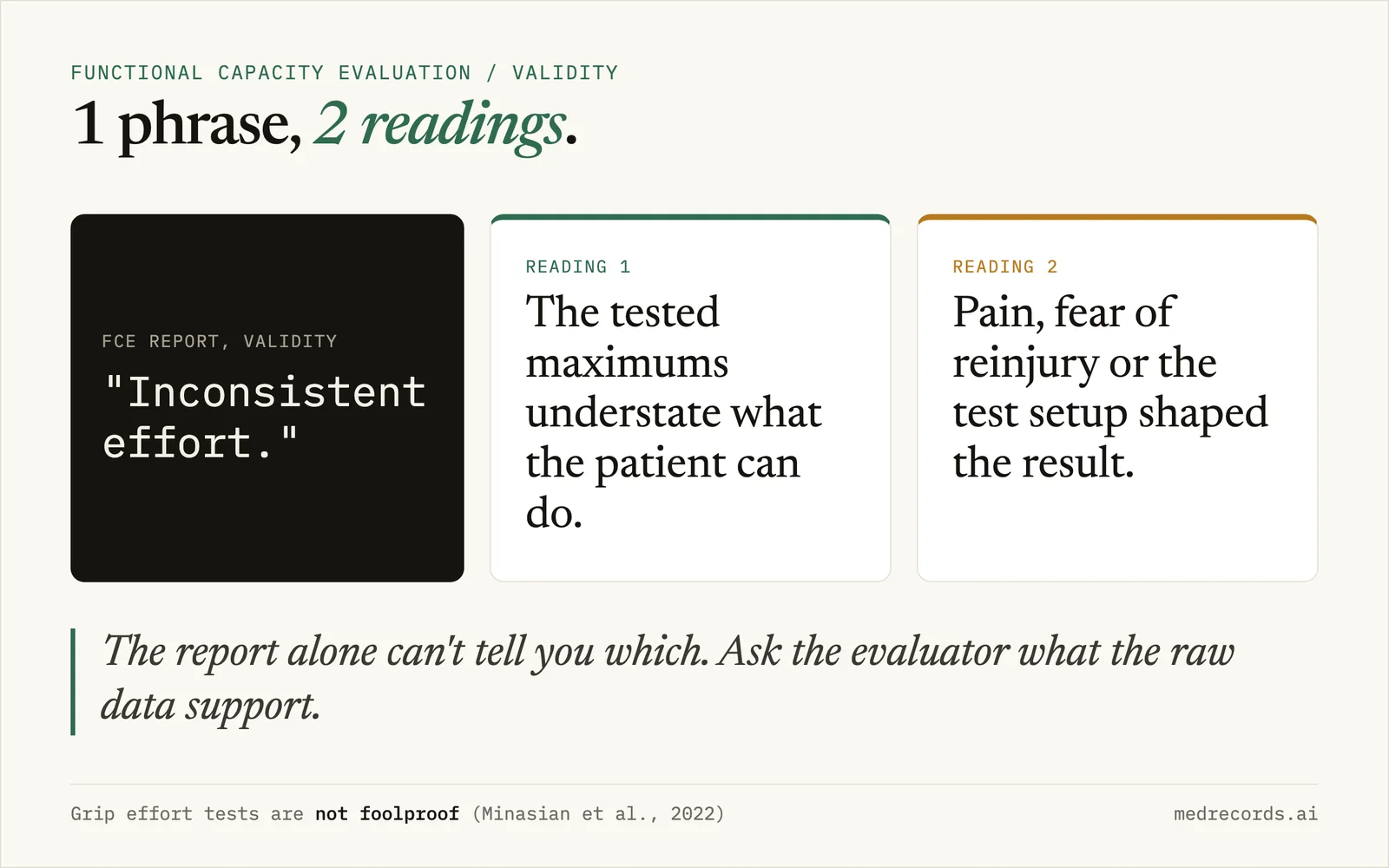
None of these signs proves intent. A 2022 review of grip testing from Cedars-Sinai (Minasian, Kuschner and Lane) notes that coached subjects can produce submaximal efforts that look like the sincere maximal efforts of injured patients, and says of the grip methods the AMA Guides recommend that "these methods are not foolproof." It also warns physicians to use caution before labelling anyone a malingerer.
So read "inconsistent effort" both ways before you sign restrictions on it. It can mean the tested maximums understate what the patient can do, or that pain, fear of reinjury or the test setup shaped the result. Ask the evaluator which reading the raw data support: a valid estimate, a minimum, or not usable for this question. Then name the inconsistency in your restriction note instead of quietly adjusting the numbers.
When should a physician order an FCE?
Order an FCE when treatment has plateaued and a work question needs a measured answer. Maximum medical improvement is not a universal prerequisite, but some states require it. New York allows the FCE only at MMI in the attending physician's opinion, and not before 3 months post-injury unless a significant documented change justifies it.
New York also limits who qualifies. The patient must be preparing to return to a previous job, have a verified new job offer, or be working with a rehab provider toward a set vocational goal. That is a state rule, not a national one, but it is a sound filter anywhere: if no job question exists, the FCE has nothing to answer.
Good Shepherd lists other common triggers: after all needed testing and treatment, after a plateau in physical therapy, after work hardening or conditioning, as part of an IME, for fit-for-duty, and when a worker asks to move into a more demanding job. See our guide to maximum medical improvement for how MMI is set state by state.
When should you hold off on ordering an FCE?
Hold the order when the patient cannot test safely or cannot follow the test. Physiopedia lists 2 contraindications: medical conditions such as cardiac, pulmonary or psychological ones, and difficulty communicating or understanding instructions. Its readiness checks:
- Recent surgery: fully healed and cleared by the attending surgeon.
- Medical stability: healing is complete, or the symptoms stay in a consistent location even if their intensity varies.
- Chronic pain: the test may raise pain intensity, but the patient stays medically stable.
- Diagnosis: confirmed before testing.
- MMI: not required on this list, and a patient may arrive deconditioned after time off. State rules such as New York's can still require it.
- Medical exam: a physician can clear the patient or list the modifications the test needs.
Match the test to the problem. If the limits are cognitive, memory-related or psychiatric, DeBofsky's guide notes that a neuropsychological evaluation may fit better than an FCE. A desk job is not a reason to skip one: sit-stand tolerance and hand dexterity tests capture limits that lifting numbers miss.
What should go with the FCE referral?
Send the evaluator what it needs to test the right job safely. Froedtert's program requires a physician order and asks for:
- Pertinent medical information.
- Job demands, ideally a written job description.
- Specific referral questions or the reason for referral.
- The order itself, with diagnosis, contraindications or restrictions for testing, or approval to test to maximum tolerance.
The evaluator reviews these before testing. Missing records produce a weaker test: an evaluator who does not know about a prior lumbar fusion cannot set safe test limits for it. A cited medical chronology of the chart, with missing records flagged, is the fastest way to send a complete packet.
What does a clinic need to run an FCE service line?
A clinic needs an evaluator trained beyond the license who stays for the whole test, a standardized protocol with published reliability data, a referral packet that includes the job's demands, and time records that support billing under 97750. Physicians judge the service by the report, so build the workflow backward from it.
| Requirement | What the sources say | Source |
|---|---|---|
| Evaluator | A PT or OT with added training to administer and interpret FCEs, assess workplace demands and apply workers comp rules. The evaluator knows the history and the pre-injury job, and is present for the whole test | Sheltering Arms Institute |
| Protocol | As of Chen's 2007 review, about 10 systems were in common use, including Blankenship, Ergos, Ergo-Kit, Isernhagen, WEST-EPIC, Key and ARCON. The systematic review Chen summarizes covered 4 of them: Isernhagen had consistent interrater reliability but too little intra-rater evidence to conclude, Blankenship had no published study, and Ergos and Ergo-Kit showed no concurrent validity. The 2018 update by De Baets covered 20 studies on 9 methods: Isernhagen reliability was moderate to high but predictive validity low, and WorkHab reliability was moderate to high. Cite the newer review, and check for studies on your own system | Chen 2007; De Baets 2018 |
| Job match | Pair the FCE with a job analysis or ergonomics consultation by the same therapist. It sharpens the match and lets you suggest job modifications, and the kit includes job simulation equipment | Froedtert |
| Billing time | 97750 is billed per 15 minutes and already includes the time to analyze and interpret data. Document total contact time, protocol time and post-test instruction time | webFCE billing notes |
| Other codes on the same day | Coding 97750 with an E/M or PT evaluation code is "atypical" but can be done | webFCE billing notes |
| Psychometric questionnaires | In New York workers comp, testing by a provider who is not a psychologist or psychiatrist is part of the FCE charge and cannot be billed separately. Testing by a licensed psychologist or psychiatrist bills under that fee schedule | NY WCB FCE-4 |
| Standardized tools | In New York workers comp, tools must be standardized, with normative data and interpretive guidelines attached to the report | NY WCB FCE-4 |
The protocol row is the one a reviewing physician or opposing expert will probe. If your system has thin published evidence, say so in the methodology and let the raw data carry the result: the repeat trials, the heart rate response, the consistency checks. Show the work instead of leaning on the brand name.
Then write the report for the reader who will check it. The ordering physician, IME or QME compares it with the chart (the 7 checks below), so state the diagnosis and levels tested, the medications taken that day, the precautions you respected and the job description you tested against. Most of those rows are settled at intake. Do not schedule until the surgical precautions and the job description are in hand.
How do physicians use FCE results on disability forms?
Physicians use the FCE to set or confirm restrictions, then state those restrictions in their own words on the form the payer requires: a work status note, an attending physician statement for a disability insurer, or a medical source statement for Social Security. The signature is the physician's, so the numbers must match the chart.
For Social Security claims, translate the FCE into SSA's exertion levels. 20 CFR 404.1567 defines them by weight:
| SSA exertion level | Most lifted at a time | Frequent lifting or carrying |
|---|---|---|
| Sedentary | 10 lb | Occasional light articles such as files and small tools |
| Light | 20 lb | Up to 10 lb |
| Medium | 50 lb | Up to 25 lb |
| Heavy | 100 lb | Up to 50 lb |
| Very heavy | More than 100 lb | 50 lb or more |
SSA defines residual functional capacity in 20 CFR 404.1545 as "the most you can still do despite your limitations," assessed from all the relevant evidence. An FCE is part of that evidence, not the RFC itself. 3 parts of the rule shape what you write:
- Your statement counts without a formal exam. SSA considers what medical sources say a patient can still do, whether or not a formal examination backs it. An FCE adds measured numbers to your opinion. It is not a precondition for giving one.
- The RFC is used at 2 steps. At step 4, SSA compares it with the patient's past relevant work. At step 5, SSA does not decide disability from the RFC alone; it weighs the RFC together with the patient's vocational background.
- Light work implies sedentary, with exceptions. Under 404.1567, someone who can do light work is also found able to do sedentary work, unless other limits apply, such as loss of fine dexterity or an inability to sit for long periods. If the FCE or the chart shows either, name it on the form. Otherwise a 20 lb lifting limit reads as light work, and sedentary follows.
Your medical source statement carries more weight when it cites the FCE and the treating record together.
Courts read it the same way. DeBofsky Law's summary of Scanlon v. Life Insurance Co. of North America (7th Cir. 2023) says FCEs must be weighed alongside treating physician evidence, not in isolation. For the long-term disability side, see LTD claim record review and Social Security disability record review.
FCE vs impairment rating
An FCE measures what the patient can do. An impairment rating states a percentage of permanent impairment under the AMA Guides, set by a physician, usually after MMI. They work together: Good Shepherd calls the FCE part of the physician's final impairment rating, and Sound Medical Evaluations writes that in California, a QME may use FCE data to support or refine impairment conclusions.
Does an FCE determine disability?
No. An FCE measures physical function on 1 day; a disability decision weighs that function against vocational, educational and psychosocial factors, and a physician, insurer, judge or board makes it. Chen's 2007 review draws the same line between impairment, a medical finding, and disability, which takes in work, education and money.
The FCE still moves claims. Chen notes that a completed FCE commonly leads to claim closure, and that disability benefits were suspended an average of 32 days after the FCE in the studies reviewed. That is why the report needs to be right, and why the treating physician should read it closely rather than forward it.
How does an FCE feed into a workers comp settlement?
Not by itself. In workers comp, the FCE informs permanent restrictions and the impairment rating, and those feed the permanent disability figure that drives settlement. A QME or IME physician integrates FCE results into the report and must square them with the clinical picture. For that review, see workers comp IME record review.
Test the FCE report against the chart
Before you sign restrictions based on an FCE, match each claim in the report to a page in the medical record. The 7 checks below are our method, built from the report standards above.
On 2026-11-03 we pulled Google's top organic results for 6 searches ("functional capacity evaluation", plus "cost", "report", "validity", "how long does a functional capacity evaluation take" and "fce physical therapy"). That gave 51 results, 24 of them clinic pages offering the test. We then read 19 pages in full: 9 from those results, plus clinic, vendor, payer and legal pages from related searches, all listed under Sources with the regulations and studies we checked. None of those 19 walks the ordering physician through this check.
| Check | What passes | Where the proof is in the chart |
|---|---|---|
| Diagnosis and body part | The FCE tested the conditions you are treating, at the right levels | Problem list, imaging reports, op notes |
| Medications on test day | The report states what was taken, and it matches the current list | Medication list, last visit note |
| Prior function | The pre-injury baseline in the report matches the history | Intake history, prior records |
| Job demands | The demands tested match the actual job description | Employer job description, vocational records |
| Effort and consistency | Both are stated separately, with the signs used | FCE raw data, grip and heart rate tables |
| Contraindications | Test limits respected your order and any surgical precautions | Your FCE order, surgeon's restrictions |
| Restrictions vs exam | The recommended limits fit your latest exam findings | Last 2 or 3 visit notes |
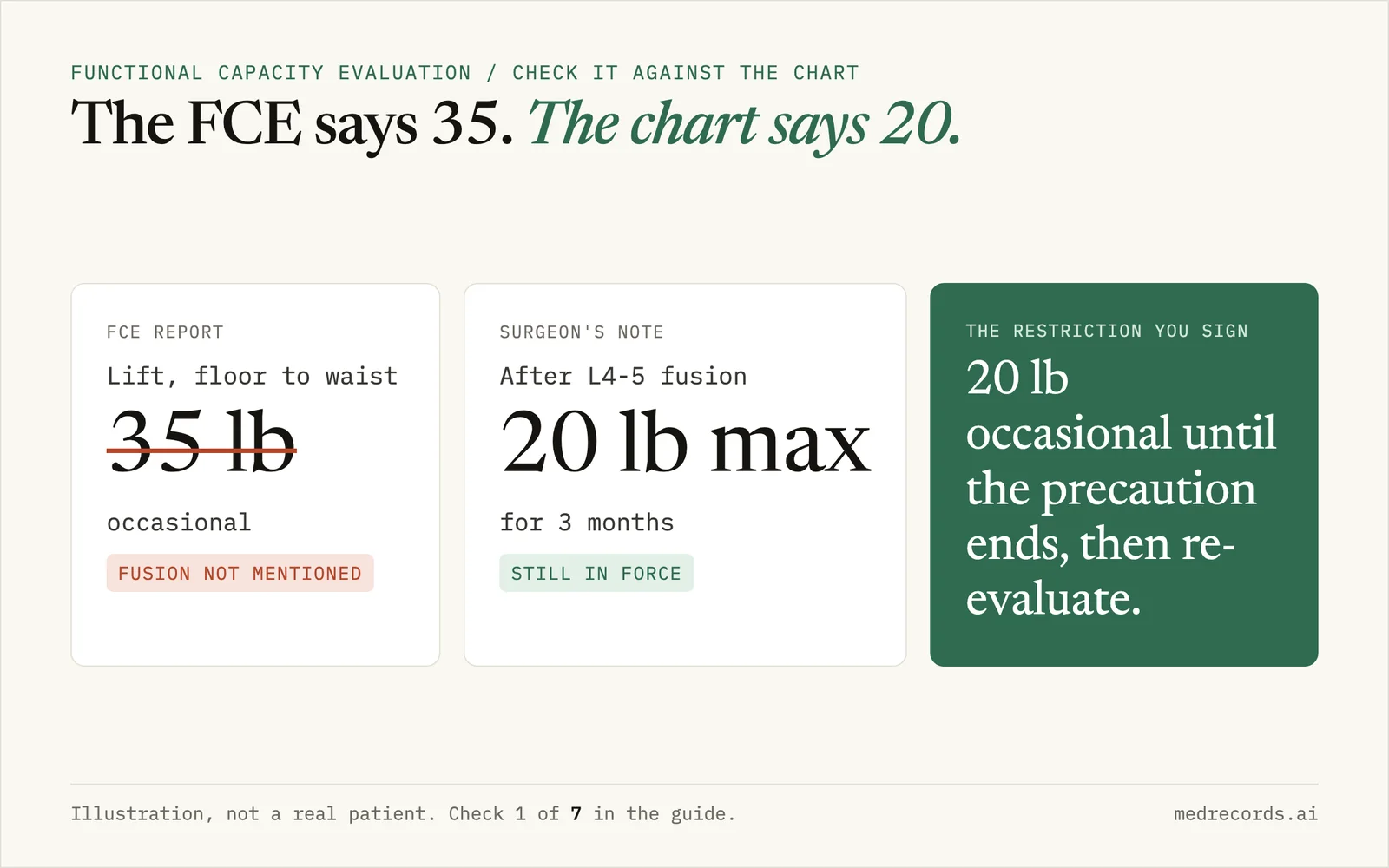
Here is how a failed row looks in practice. This is an illustration we wrote, not a patient and not a Medrecords output. The FCE recommends a 35 lb occasional lift. The surgeon's note 6 weeks earlier says no lifting over 20 lb for 3 months after an L4-5 fusion, and the FCE report never mentions the fusion. The contraindications row fails. Keep the FCE and write the conflict into the note: "FCE of [date] tested to 35 lb occasional. Surgical precaution of [date] limits lifting to 20 lb through [date]. Restriction: 20 lb occasional until then, re-evaluate after." Each number in that note points to a page. A summary line reading "FCE: 35 lb occasional" would have hidden the conflict; the page citations expose it. That is what we mean when we say complex records are an evidence problem, not a summarization problem.
Medrecords AI speeds up the chart side of the table. It reads the file and builds a cited chronology where every line cites its source page, so the diagnosis, surgical precautions and latest exam findings for rows 1, 6 and 7 sit 1 click from the page. Record Q&A answers a question such as "what was on the medication list on the FCE date?" with the page cited, and missing-records detection flags an op note that is referenced but never arrived. For IME and QME work, it drafts the report with those citations in place. You review, revise and sign.
In our demo case (342 pages in 2 packets, a right knee), it removed 11 duplicate pages and quarantined a wrong-patient page at p.140. A stray page like that is how another patient's medication list ends up next to an FCE. That file bills 331 pages at 10¢, or $33.10.
"Even an hour (to process a full case file) is super fast. I was worried it might take 2 or 3 days."
What it does not do: perform FCEs, write FCE reports, retrieve records, judge whether the FCE protocol was sound, or sign restrictions. The effort and job-demand rows still depend on the evaluator's raw data and your judgment. If the chart is 60 pages you can read in 20 minutes, read it by hand. For a PT clinic that runs FCEs, the useful part is intake: a cited chronology of the referral packet shows the diagnosis, precautions and medications the test has to respect before the patient arrives. Pricing is 10¢ per deduplicated page, down to 5¢ at volume, with duplicates never billed and no subscription.
The short answer
An FCE is a 2-hour to 2-day measured test of work function, usually run by a licensed PT or OT and billed under 97750. Order it at or near MMI with a job question to answer, read effort and consistency separately, and check it against the chart before the restrictions go on any form.
- Ordering one: confirm the patient is stable and cleared after any surgery, then send the order, diagnosis, test limits, job demands and referral questions.
- Reading one: look for a job-demand comparison, raw data, separate effort and consistency findings, and a narrative per activity.
- Filling out a disability form: state restrictions in your own words, map them to SSA exertion levels where needed, and cite the FCE and the chart together.
- Running an FCE service line: use a protocol with published reliability data, document contact, protocol and instruction time for 97750, and attach normative data where your state requires it.
AI does the reading and helps you make the call. The last word is yours. Book a demo. First case is free on us. Or see pricing.
Bring us your ugliest case. In a live demo we build the cited chronology for a chart you need to sign off on, and you check any row against its page. First case is free on us.
Frequently asked questions
Does insurance pay for a functional capacity evaluation?
It depends on who orders it. When a workers comp carrier, disability insurer or employer requests the FCE, that party pays. In New York workers comp, no prior authorization is needed, but the bill must be attached to the report. A patient who self-refers may pay cash, with published prices from $660 to $916 on MDsave as of 2026-11-03.
How long are FCE results good for?
No source we reviewed sets a fixed expiry for FCE results. The report measures function on the test day, so treat it as current only while the condition and the job stay the same. Repeat the FCE after surgery, a significant change in status, a new job offer or a new referral question that the first test did not address.
Is a workers comp settlement determined by the FCE?
No. The FCE informs permanent restrictions and the impairment rating, and those feed the permanent disability figure behind a settlement. The treating physician, QME or IME physician integrates the FCE with the clinical record, and the parties or a judge settle the claim. A strong FCE with a weak chart rarely carries a case alone.
What happens after a functional capacity evaluation?
The evaluator sends the report to the referral source and the treating physician; BlueHive quotes 5 to 7 business days. The physician then sets or confirms restrictions, and the employer or insurer decides on return to work, modified duty or benefits. Claims often close soon after: Chen's 2007 review found benefits suspended an average of 32 days after the FCE.
How should a patient prepare for an FCE?
Tell patients to sleep well, take their prescribed medications as usual, and avoid large doses of caffeine before the test, as BenchmarkPT advises. They should wear comfortable clothes and shoes, bring any assistive devices, and tell the therapist about pain, dizziness or fatigue during testing. Those reports are recorded and used in the results.
What is the difference between an FCE and an RFC?
Residual functional capacity is Social Security's finding of the most a claimant can still do despite limitations, under 20 CFR 404.1545. An FCE is a physical test that produces evidence for that finding. A physician's medical source statement can cite the FCE, but SSA sets the RFC from all the evidence in the file.
Does Medrecords AI perform FCEs?
No. Medrecords AI does not perform FCEs, retrieve records or sign restrictions. It reads the chart and the FCE report, builds a page-cited chronology, flags missing records, and drafts IME and QME report sections with citations. The physician reviews the draft, sets the restrictions and signs. The software is SOC 2 and HIPAA compliant, with a BAA at signup.
Sources and method
Vendor prices and features below come from public pages captured on the dates shown. Vendors change pricing often, so confirm before you buy.
- Johns Hopkins Medicine: functional capacity evaluations (captured 2026-11-03)
- MedStar Health: functional capacity evaluation (captured 2026-11-03)
- Physiopedia: functional capacity evaluation (captured 2026-11-03)
- ATI Physical Therapy: functional capacity evaluations (captured 2026-11-03)
- Sheltering Arms Institute: what is a functional capacity evaluation (captured 2026-11-03)
- Froedtert: functional capacity evaluation (captured 2026-11-03)
- Good Shepherd Rehabilitation: functional capacity evaluation (captured 2026-11-03)
- BenchmarkPT: what to expect at a functional capacity evaluation (captured 2026-11-03)
- MDsave: functional capacity evaluation prices (captured 2026-11-03)
- NYSED ACCES-VR: functional capacity evaluation (captured 2026-11-03)
- BlueHive: functional capacity evaluation guide (captured 2026-11-03)
- webFCE: pricing and CPT 97750 fee schedule table (captured 2026-11-03)
- URPT: 4 items every FCE report should include (captured 2026-11-03)
- Enlyte: FCE frequently asked questions (captured 2026-11-03)
- Sound Medical Evaluations: FCE in workers compensation (captured 2026-11-03)
- DeBofsky Law: how an FCE can help prove disability (captured 2026-11-03)
- Washington L&I: functional capacity evaluation elements (PDF) (captured 2026-11-03)
- New York WCB: FCE-4 practitioner's report and requirements (PDF) (captured 2026-11-03)
- Chen JJ. Functional capacity evaluation and disability. Iowa Orthop J. 2007;27:121-127 (PMC) (captured 2026-11-03)
- De Baets S, Calders P, Schalley N, et al. Updating the evidence on functional capacity evaluation methods: a systematic review. J Occup Rehabil. 2018;28(3):418-428 (PubMed) (captured 2026-11-03)
- Minasian RA, Kuschner SH, Lane CS. A review of handgrip strength and its role as a herald of health. Open Orthop J. 2022;16 (captured 2026-11-03)
- 20 CFR 404.1567, physical exertion requirements (captured 2026-11-03)
- 20 CFR 404.1545, residual functional capacity (captured 2026-11-03)
- Medrecords AI pricing (as of 2026-11-03)