Fetal Monitoring Strip-to-Chart Timeline Sample
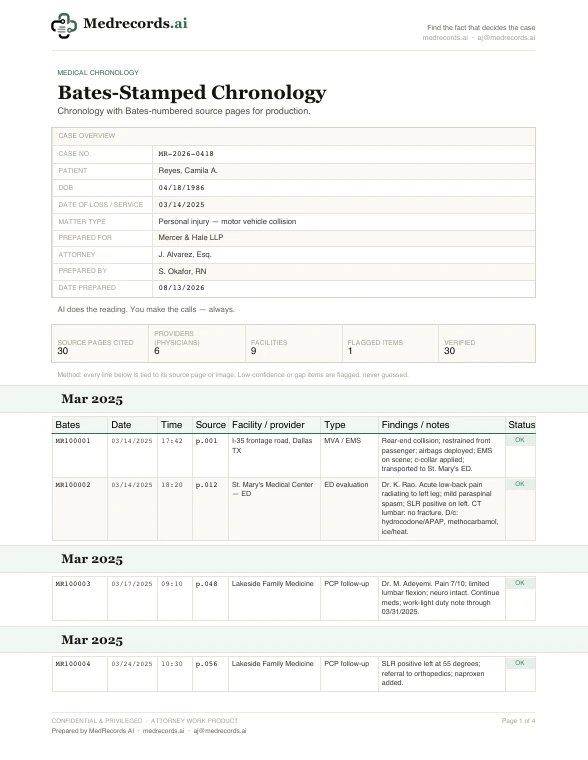
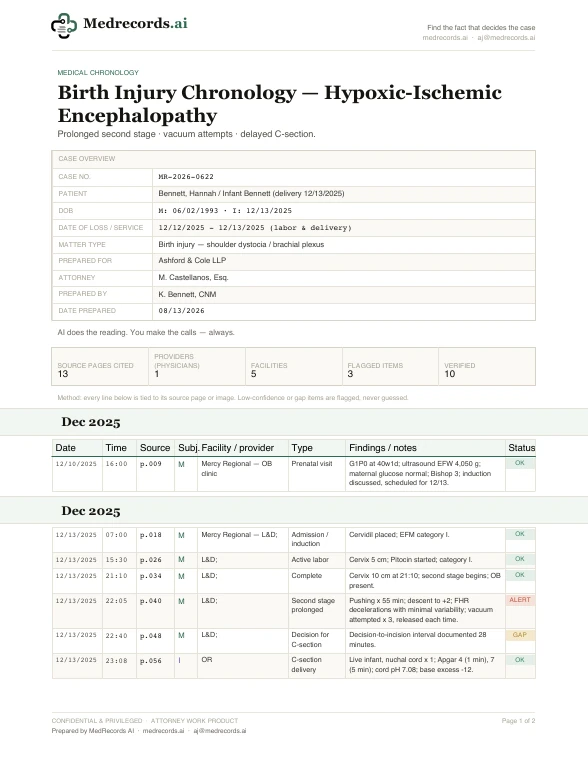
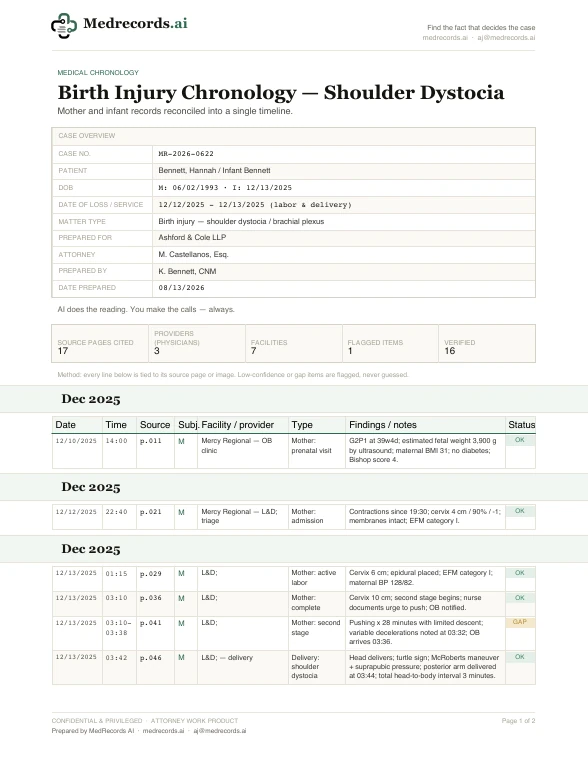
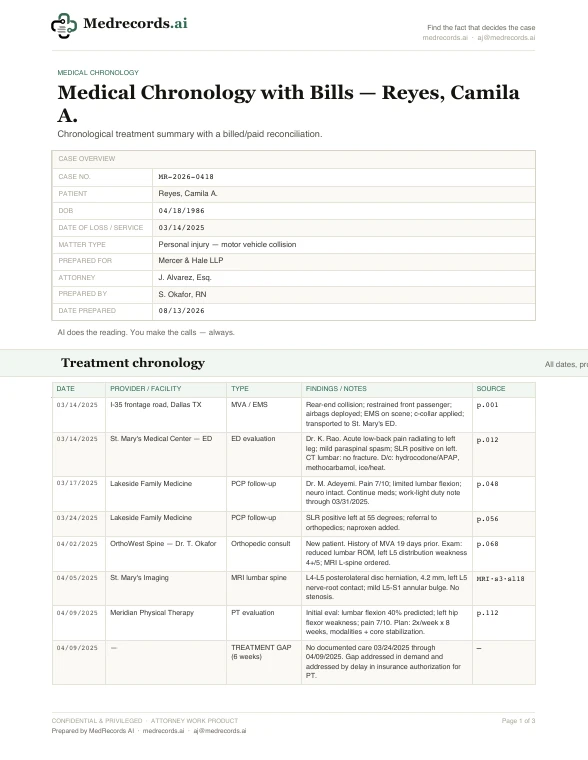
Fetal monitoring strip-to-chart timeline sample for a fictional induced labor ending in cesarean: 3 clock anchors showing the monitor 6 minutes ahead of the EHR, every tracing-related entry in time order with its page, 1 conflicting time, 1 late addendum and 3 tracing gaps flagged. A hand-built illustration of the format.
What’s inside this labor and delivery medical chronology
- Clock anchors: 3 events recorded by 2 systems, with the offset each one shows
- Every tracing-related entry in EHR time, with the monitor time kept beside it
- Conflicting times, late entries and periods with no tracing pages flagged, not judged
- A gap table ready to send to the records custodian
| Record set | Fictional induced labor ending in cesarean: labor flowsheet, nursing notes, MAR, pump log, orders, OR and anesthesia records, 22 tracing segments |
|---|---|
| Clock | EHR time, with the monitor time kept beside each entry; 3 anchors show a 6-minute offset |
| Flags | 1 conflicting time, 1 late addendum, 3 periods with no tracing pages |
| Not included | No reading of the tracing and no NICHD category; those are for the retained experts |
This is a hand-built illustration of the Medrecords AI output format on a fictional labor, written to match the worked example in our guide to fetal monitoring strips in birth injury cases. It was not generated from a real file. Medrecords AI does not read the tracing or assign categories (the categories come from ACOG Clinical Practice Guideline No. 10); it cites and flags the chart entries around it.
How Medrecords AI does this work
See how Medrecords AI lays out a labor and delivery file: every entry cited, clocks kept apart, gaps flagged for the people who decide what they mean.