Guides › What is a life care plan
What is a life care plan? A guide for physicians
A life care plan is an itemized projection of the care, equipment and support a person will need for life after a catastrophic injury or chronic condition, with a frequency, duration and cost on every item. Planners write it under published standards, using a definition adopted in 1998, and physicians supply the medical foundation.
- ›Every item in a plan carries a frequency, a duration, a replacement cycle and a unit cost. AAPM&R's worked example: a $12,000 item replaced every 4 years averages $3,000 a year.
- ›Nurses, rehabilitation counselors, physicians and psychologists all write plans. Items outside the writer's scope need a clinician's recommendation, and the 2025 Summit says plans "shall rely on medical/allied health professional opinions."
- ›The common route for your opinion into someone else's plan is a reiteration letter, sent back "for review and authentication". Sign only what you recommended and what your chart supports.
- ›Treating or retained changes the paperwork. Under FRCP 26, a retained expert signs a written report; a treating physician can testify "without any requirement for a written report".
- ›The wording standard depends on the court. Ask counsel whether "certainty" or "probability" applies before you sign anything.
What is a life care plan, and what is it not?
A life care plan is a written, costed projection of future care for 1 person, built from the records and from clinician recommendations. It is not an advance directive, an IME report or the treatment plan you write for the next visit.
The consensus definition calls it "a dynamic document based upon published standards of practice". The International Conference on Life Care Planning and the International Academy of Life Care Planners (IALCP) adopted that wording in April 1998, and AAPM&R's February 2026 review still cites it. Katz, in a 2019 review, calls planning "a method of estimating future care costs" for patients with catastrophic disabilities.
Costing is only part of the job. The 2022 Standards of Practice list "an appropriate plan of rehabilitation, habilitation, prevention, and reduction of complications" as goal 1, and put costs at goal 3. The same document names who uses plans: case managers, third party payors, trust managers, government bodies, workers' compensation, and courts hearing malpractice, product liability and personal injury cases.
3 neighbors get confused with it:
- Advance care plan or advance directive. The patient's own wishes about future treatment. In 1 of our 3 Google pulls for "life care plan", Kaiser Permanente ranked first with an advance care planning page.
- IME report. 1 examiner's answers to a referral question after 1 exam. See how to write an IME report.
- Impairment rating. A percentage tied to an MMI date. See maximum medical improvement by state.
Who writes a life care plan, and where does the physician come in?
Nurses, rehabilitation counselors, physicians and psychologists all write life care plans, per the IALCP. Whoever writes it, items outside the writer's scope need a clinician's recommendation, and that clinician is the physician, therapist or specialist who treats or consults on the patient.
Standard 12a of the 2022 Standards of Practice has the planner seek "recommendations from other qualified professionals" for items "outside the life care planner's scope of practice." The 2025 Life Care Planning Summit put it more bluntly in Statement 64: "Life Care Plans shall rely on medical/allied health professional opinions." Statement 60 adds that planners "shall utilize adequate medical and other data for opinions."
Scope decides who opines. In an IDC Quarterly feature, Keesler, an RN and planner, describes an RN planner who costed a 4-level spinal fusion as the only option and ignored the other documented opinions. The verdict: an RN does not make surgical decisions, so that planner acted outside an RN's scope.
A physician who writes the plan has the edge AAPM&R names: "A physician can independently formulate and defend medical opinions". The same review names the weak point of plans built without one: "The lack of input from treating physicians... can play a role."
PT practices and clinic nurse case managers sit inside the same process. Standard 9d has the planner gather information from "relevant treating or consulting health care professionals", so your therapy notes, home program and equipment orders become source material. Stokes & Associates, a planning firm, says records "often fail to specify the frequency and duration" of treatment. Its example is a neurosurgeon who recommends a 2-level anterior cervical fusion but sets no follow-up visits, PT, labs, imaging, medication or equipment. The planner fills those gaps by asking you.
What goes into a life care plan?
Every item carries the same fields: what it is, who recommended it, how often, for how long, when it is replaced, what it costs and where the price came from. The 2022 Standards of Practice group the items into 3 categories.
- Medical care. "Preventive and restorative health, wellness, and medical care", covering providers, diagnostics, surgery, medications and supplies.
- Equipment and adaptive aids. Mobility devices, orthotics, prosthetics and assistive technology.
- Community support and access. Home attendant or facility care, household services, transportation, accessibility modifications, education and vocation.
Here is AAPM&R's worked example laid out as 1 line item, with the part your chart has to carry.
| Field | AAPM&R's worked example | What your chart has to show |
|---|---|---|
| Item | A medical equipment item | A diagnosis and the functional need |
| Recommended by | The clinician named in the plan | Your order or note, if the plan names you |
| Unit cost | $12,000 | Nothing; pricing is the planner's job |
| Replacement cycle | Every 4 years | A reason that cycle fits this patient |
| Annual cost | $3,000 averaged | Nothing; it is arithmetic |
| Duration | Life expectancy | Prognosis, comorbidities and function |
AAPM&R adds that an economist can calculate the exact yearly cost when the first and replacement costs are known, then states the total in present value, the figure a jury is asked to consider. Each cost item has to be "supported by medical records, treating provider recommendations" or guidelines and literature. AAPM&R writes that across most plans, attendant and nursing care is "the largest projected lifetime expense", so hours per day and level of care (CNA, LPN or RN) deserve your closest read.
Duration rests on life expectancy, and that is a medical question. Katz says planners "must use scientifically sound methods" to set it. AAPM&R prefers condition-specific survival data to general population life tables, which come from a mostly healthy population. Expect a planner to ask you about prognosis.
To see the fields on a blank sheet, open the life care plan cost projection worksheet. For the physician side, the medical foundation sample shows a sample foundation built on a demo case.
Which standards govern a life care plan?
3 sources set the rules: the IALCP Standards of Practice, 4th edition (2022), the consensus statements updated at the 2025 Life Care Planning Summit, and the American Academy of Physician Life Care Planners (AAPLCP) for physician planners. They bind the planner, and they tell you what the planner will ask you for.
The Standards of Practice were first published as a stand-alone document in 2000, then updated in 2006, 2015 and 2022. The 4th edition warns that "Failure to adhere to standards of practice can adversely affect the utility and admissibility" of the plan. These are the clauses that touch your chart.
| Standard | What it says | What it means for you |
|---|---|---|
| SOP 9d | Gather information from "relevant treating or consulting health care professionals" | Expect a call, a survey or a records request |
| SOP 11i | "Considers factors such as pre-existing conditions and causally related needs in forensic cases." | Injury care and prior conditions get separated |
| SOP 11k | "Considers the probability versus possibility of need." | Each item needs a probable or possible label |
| SOP 14f | "Cites verifiable cost data." | Prices need a source, not your estimate |
| SOP 15c | ICD, CPT, HCPCS and ICF codes "to provide clarity regarding care recommendations and costs." | Codes should match your diagnosis and orders |
| SOP 15d | "Records lack of access to pertinent information." | Missing records get noted, not skipped |
| Summit 64 | Plans "shall rely on medical/allied health professional opinions." | Your opinion is the foundation |
| Summit 70 and 85 | "geographically relevant & representative prices"; "Non-discounted/market rate prices" | Pricing is local and undiscounted |
| AAPLCP | Needs rest on "a reasonable degree of medical probability" | The physician planner standard is probability |
SOP 18d also has planners seek "clarity regarding jurisdictional requirements", which is the same question you should ask counsel about wording.
What is a reiteration letter, and should I sign it?
A reiteration letter is the planner's written summary of what you recommended in a consult, sent back for your signature. Sign it after you check every item against your chart, strike what you did not say and correct what the summary got wrong.
Morrison, Ramos and Cowitz, writing in the Journal of Life Care Planning in 2025, describe the step: "Reiteration letters are commonly created following each collaboration" and are "returned to the professional for review and authentication." Keesler writes that recommendations "should be clearly identified through signature confirmation by the recommending professional", unless the item falls within the planner's own scope. Stokes & Associates calls it a summary letter and keeps only items considered "more probably than not" needed.
Your signature turns the planner's notes into your opinion. Stokes also tells attorneys to review the plan with the physician at deposition "to further confirm" the recommendations, so expect questions on each line you signed. Work through the letter in this order:
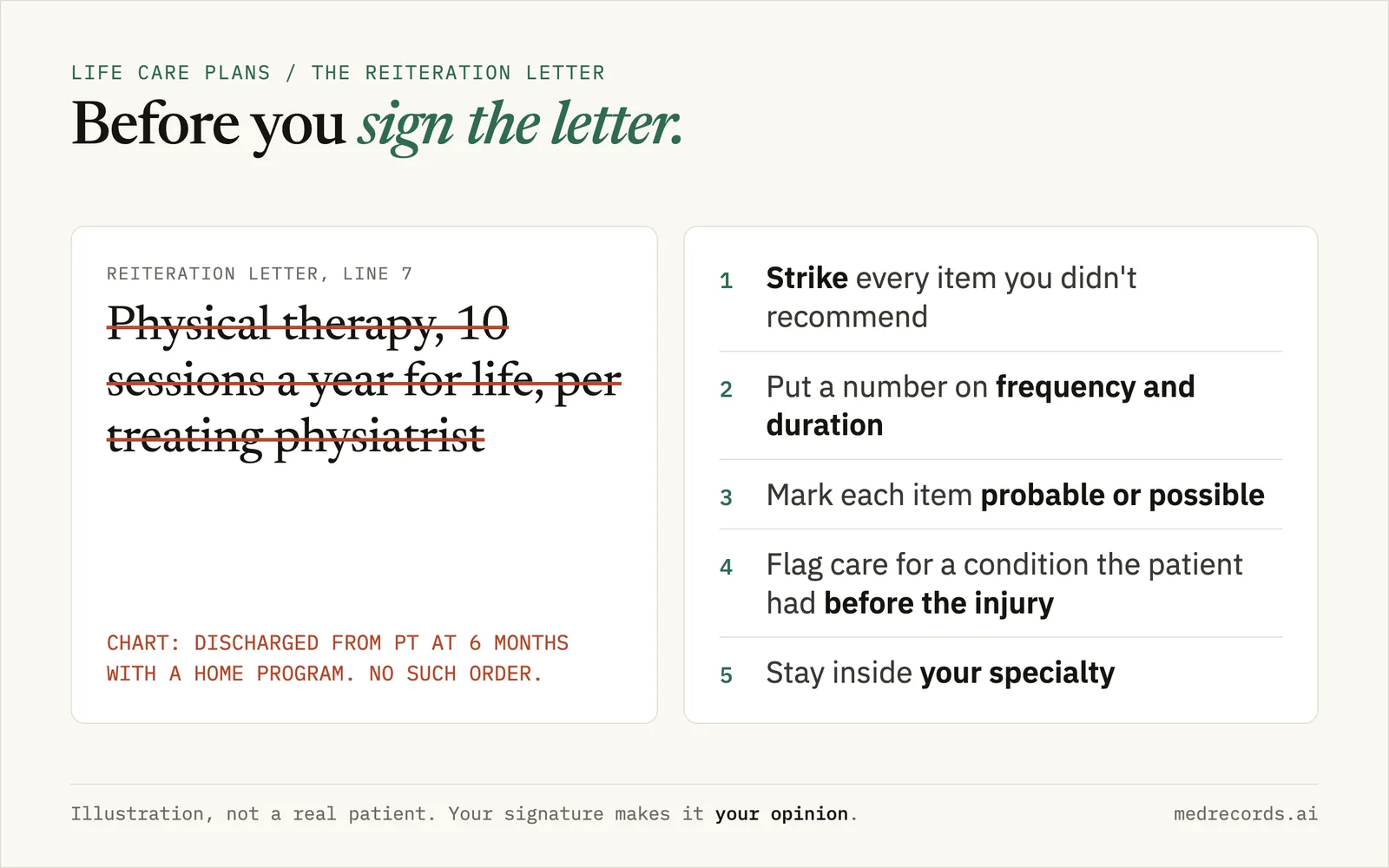
- Strike every item you did not recommend. Each line should trace to the professional who made it.
- Correct frequency and duration. "Physical therapy" with no number is not a recommendation a planner can price, and it invites a guess.
- Mark each item probable or possible. SOP 11k asks planners to weigh "probability versus possibility of need", and your label is the evidence.
- Flag causation. Mark items that treat a condition the patient had before the injury (SOP 11i).
- Stay inside your specialty. In Morrison's Canadian example, a physiatrist flags the need for a urologist but leaves the frequency of urologic care to the urologist.
- File the signed letter in the chart with the date and the records you relied on.
Sign-off is standard practice, and courts do not always demand it. A June 2026 case write-up by Exlitem, an expert witness marketplace, reports a federal slip-and-fall case in the Southern District of Florida where a PM&R physician planner's plan survived a Daubert challenge though "no treating physician endorsed a single item in the plan." The planner worked from the records and spoke to no treating physician. This is secondary reporting: the write-up does not name the case, the rest of it (including the court filings, it says) is for paid subscribers, and we could not find the order. Treat it as 1 reported ruling, not a rule.
How do I check a life care plan against my chart?
Go line by line and match each item to an entry in your chart: an order, a note or a recommendation with a frequency. Strike any item you cannot find, or mark it possible, before you sign.
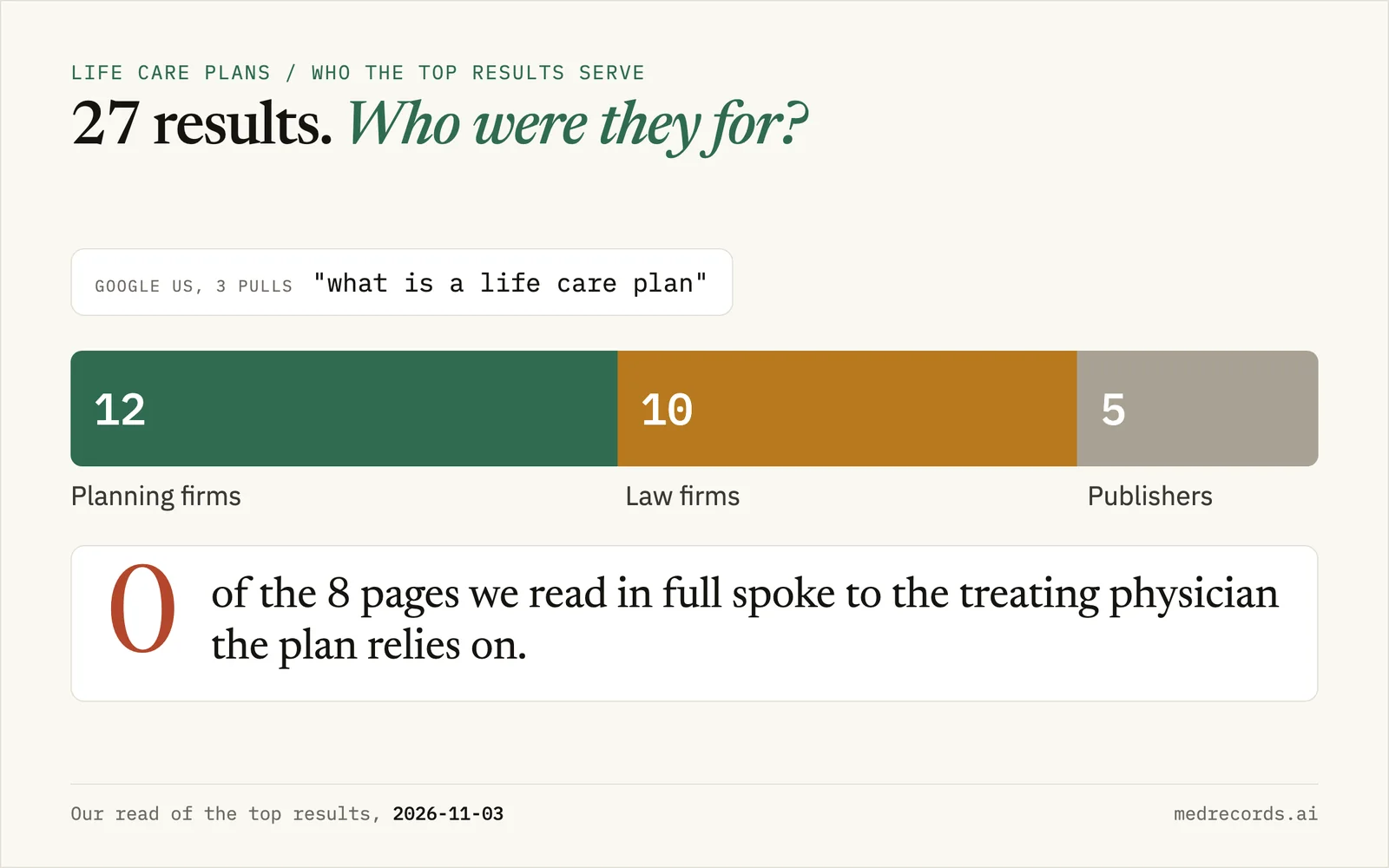
On 2026-11-03 we read the top Google results for "what is a life care plan" in 3 separate pulls. The 27 slots split into 12 planning-firm, 10 law-firm and 5 publisher results. None of the 8 pages we read in full spoke to a treating physician or a clinic, and none told a physician what to do with a reiteration letter. None of the 20 ranking pages we fetched cited FRCP 26 or covered what the clinician bills. The table below is our method, built from the standards above.
| Line-item field | What to check in your chart | Standard behind it |
|---|---|---|
| Recommending professional | Your name sits only on items you ordered or recommended | Keesler; Summit 64 |
| Causal link | The item treats the injury, not a prior condition; see the eggshell plaintiff rule | SOP 11i |
| Probable or possible | Your note supports the need as more likely than not | SOP 11k; AAPLCP |
| Frequency | Visits or sessions per year match what you wrote | SOP 11h; Stokes |
| Duration | Weeks, years or lifetime, with a reason in the note | AAPM&R; Katz |
| Replacement cycle | Equipment life fits the patient's use | AAPM&R |
| Unit cost and source | The item priced is the item you ordered, with a cited local price | SOP 14f; Summit 70 and 85 |
| Codes | ICD, CPT or HCPCS codes match the diagnosis and service | SOP 15c |
| Records reviewed | The plan's list of records includes yours, and gaps are noted | SOP 15d |
Here is how a failed row looks. This is an illustration we wrote, not a patient and not a Medrecords output. A physiatrist discharged a patient from PT 6 months after a lumbar fusion, with a home program. The reiteration letter lists 10 PT sessions per year for life, "per treating physiatrist." The chart has no such order. The fix is to strike the line, or rewrite it to match the discharge note, before you sign.
Medrecords AI reads the packet, removes duplicates and drafts a cited chronology where every entry cites its source page (how citations work), so each order, op note and therapy discharge sits on 1 timeline you can hold a plan against. Missing-records detection flags records the packet refers to but does not contain, and wrong-patient pages are quarantined.
What it does not do: write the life care plan, recommend care, price items, estimate life expectancy or sign anything. Those stay with the planner and with you. Pricing is 10¢ per deduplicated page, down to 5¢ at volume, with duplicates never billed and no subscription.
Am I testifying as a treating physician or a retained expert?
In federal court, it depends on why you are involved. A retained expert signs a written report under FRCP 26(a)(2)(B); a treating physician who was not retained is disclosed with a summary of facts and opinions under 26(a)(2)(C).
| Question | Treating physician (not retained) | Retained physician expert or planner |
|---|---|---|
| Federal rule | FRCP 26(a)(2)(C) | FRCP 26(a)(2)(B) |
| Written report | Not required; the disclosure gives "a summary of the facts and opinions" | Required, "prepared and signed by the witness" |
| Who fits | 2010 note: "Frequent examples include physicians or other health care professionals" | A witness "retained or specially employed to provide expert testimony" |
| Testimony | Can be "deposed or called to testify at trial" with no report (1993 note) | Deposed on the signed report |
| If you hold both roles | AAPLCP asks physician planners to "avoid serving as both" | Where both exist, explain "the responsibilities and boundaries of each" |
Some physicians do hold both roles. Fletcher, a physician planner, writes on the practice site of having "prepared LCPs for patients" while serving as their treating physician. AAPLCP ethics do not forbid it, but they ask for clear lines between the 2 jobs.
State courts set their own disclosure rules. In a state case, or if you are asked to write or co-sign the whole plan, ask counsel which category you fall in before you write anything longer than a chart note.
Medical certainty or medical probability: which wording applies?
It depends on the court and the state, so ask the requesting counsel before you sign. Under Federal Rule of Evidence 702, amended in 2023, the party offering your testimony must show it is "more likely than not" that each reliability element is met.
The 2023 committee note calls that "the preponderance of the evidence standard". The phrase "reasonable degree of medical certainty" has a legal history, not a scientific one: NIJ traces its first use to Herbst v. Levy in 1935. The DOJ's National Commission on Forensic Science said such terms "have no scientific meaning and may mislead factfinders", and the 2023 note warns forensic experts off "a reasonable degree of scientific certainty" when the method is subjective.
Guileyardo, in a 2015 Baylor University Medical Center Proceedings editorial, treats the 2 phrases as different levels. Certainty "is the level of proof required in criminal proceedings". Probability means "greater, but not significantly higher, than 50%" and governs "most civil (tort) proceedings". That is 1 author's framework, and courts vary.
Planning bodies lean toward probability. AAPLCP sets needs at "a reasonable degree of medical probability", and SOP 11k asks planners to weigh probability against possibility. Some physician planners still testify "within a reasonable degree of medical certainty", and Stokes mixes both in 1 sentence.
Use the wording the jurisdiction requires, and make the chart say the same thing. A note that says a patient "may need" surgery and a letter that says "more likely than not" hand opposing counsel an easy question on cross-examination. For how a causation opinion is worded and supported, see the medical causation expert opinion sample.
What records does a planner need, and how do I release them?
Planners ask for the full medical record plus non-medical sources, and your clinic releases its part under HIPAA. Without a patient authorization, the routes are a court order, a subpoena that meets 45 CFR 164.512(e), or a state workers' compensation law under 164.512(l).
The IALCP lists medical records alongside "depositions, day in the life videos, school records, employment records, and tax returns". SOP 9c widens it to "health, biopsychosocial, medical, financial, educational, and vocational history". For a clinic, the release paths are:
- Patient authorization. The usual route when the patient or the patient's attorney asks. Send what the authorization names, no more.
- Court or administrative order. 45 CFR 164.512(e)(1)(i) permits disclosure in response to an order, but only of "the protected health information expressly authorized by such order". Read the order before you pull the chart.
- Subpoena or discovery request with no order. Permitted with written "satisfactory assurance" that the patient was notified and the time to object has passed, or that the parties sought "a qualified protective order". Under 164.512(e)(1)(v), that order bars use of the records outside the case and requires their return or destruction, copies included, when the case ends.
- Workers' compensation. 164.512(l) allows disclosure "as authorized by and to the extent necessary to comply with" workers' compensation laws, so the state's rules set the limit.
After release, ask the planner which records the plan relied on and compare that list with your release log. Do not count on the plan carrying one: the 2025 Summit archived Statement 61, which had called for "an annotated list of requested and reviewed data/sources". SOP 15d still has the planner record "lack of access to pertinent information." If the plan cites your clinic but the list lacks your notes, the recommendation rests on someone else's summary of your care. Planners who need help sorting those records can see record review for life care planners.
What can I bill for life care plan work?
In the 2 workers' compensation systems we checked, testimony bills under CPT 99075 (Georgia) and special reports under 99080 (Pennsylvania). Other payers and states set their own codes and rates, so ask before you start. In federal litigation, the party seeking discovery from an expert pays "a reasonable fee for time spent in responding to discovery" under FRCP 26(b)(4)(E).
| Setting | Code or rule | What the source says | Date and caveat |
|---|---|---|---|
| Pennsylvania workers' comp | CPT 99080 | Paid "only if these reports are specifically requested by the insurer", "at 80% of the provider's usual and customary charge" | 34 Pa. Code 127.130, current |
| Georgia workers' comp | CPT 99075 | Up to $600 for the first hour, then $150 per added 15 minutes, paid within 30 days | Georgia SBWC; the rate sheet is dated 2011-04-01, and the board's page for the April 1, 2026 fee schedule lists the same rate |
| Federal discovery | FRCP 26(b)(4)(E) | The party seeking discovery pays "a reasonable fee" | Current rule |
Decide before the first request how you bill a planner call and a letter review, and send the requester your fee schedule before you start. Georgia is 1 state and 1 system, so check your own state's workers' compensation board before you quote a rate.
For scale, the plan itself costs the requester far more. AAPM&R cites $5,000 to $30,000, with the top of the range including court time; its source is Rehab Care Coordination, a firm that sells planning services. LCP PRO, a planning firm, quotes $2,000 to $10,000. Both ranges trace back to firms that sell plans, not to a survey of fees.
Can a physician write life care plans?
Yes. Physicians write plans, physiatrists most of all, but life care planning "is not a part of residency milestones", so the training comes after residency.
Gonzales and Zotovas, writing in PM&R in 2014, describe planning's "capacity to complement and diversify a clinical physiatric practice". AAPM&R reports that the physician credential (CPLCP) was limited to PM&R physicians until 2024. It now accepts any specialty recognized by the American Board of Medical Specialties, with at least 10 years of clinical practice after residency. For the wider field, IARP says precertification programs "provide 120 hours of specialized training" toward the Certified Life Care Planner (CLCP) exam and its nurse and Canadian versions. The Phoenix Society calls physician-driven planning "an emerging area".
Before you take a case, decide which role you hold; the dual-role rule above applies. For planners by state, see the life care planner directory. For how planners use software on the medical foundation, see the AI-native life care planner guide.
The short answer
A life care plan is a costed, item-by-item projection of lifetime care after a catastrophic injury or chronic condition. Planners write it, and physicians supply the medical foundation it rests on.
- When a reiteration letter arrives: check each item against your chart, strike what you did not recommend, fix frequency and duration, and mark probable or possible.
- When counsel calls: ask whether you are a treating or retained witness, and which wording standard applies.
- When records are requested: release under a patient authorization, a court order or a qualifying subpoena, then check the plan's source list for your records.
- When you bill: ask the payer which code and rate apply before you start (the 2 systems above use 99075 for testimony and 99080 for reports).
AI does the reading and helps you make the call. The last word is yours. Book a demo. First case is free on us. Or see pricing.
Bring us your ugliest case. In a live demo we build the cited chronology for the chart behind the next plan you are asked to sign, and you check any row against its page. First case is free on us.
Frequently asked questions
Does a treating physician have to sign a life care plan?
It is standard practice, not a rule we could confirm. Keesler writes that recommendations "should be clearly identified through signature confirmation by the recommending professional". Courts may not always require it: an expert witness marketplace reports 1 unnamed federal case where a plan no treating physician endorsed survived a Daubert challenge, and we could not find the order. If you are asked to sign, sign only the items you recommended and your chart supports.
How is a life care plan different from an advance care plan?
They share a name and little else. A life care plan projects the care and cost a person will need for life after a catastrophic injury or chronic condition, for rehabilitation, case management or litigation. An advance care plan or advance directive records the patient's own wishes about future treatment. Search results mix the 2, so check which one a request means.
How much does a life care plan cost?
AAPM&R cites $5,000 to $30,000, with the higher end including court time, taken from a firm that sells planning services. LCP PRO, a planning firm, quotes $2,000 to $10,000. Your own time is billed separately, at rates the payer or the workers' compensation system sets (Georgia uses CPT 99075 for testimony, Pennsylvania 99080 for special reports).
What does "reasonable degree of medical probability" mean?
It means more likely than not. Guileyardo describes it as a probability "greater, but not significantly higher, than 50%", used in most civil cases, while medical certainty sits at the criminal level in that framework. AAPLCP uses the probability wording for physician planners. Courts and states differ, so ask the requesting counsel which phrase applies before you sign.
How long does a life care plan take?
Weeks, not days. KWVRS, a planning firm, quotes 30 to 60 days "from receipt of complete records". A law firm describes a 3 to 4 hour first interview, 30 to 50 hours of research and 4 to 6 weeks to finish the report. Both are seller estimates. The first clock starts at complete records, so a slow records release delays the plan.
Does Medrecords AI write life care plans?
No. Medrecords AI reads the record packet, removes duplicates, drafts a chronology where every entry cites its source page, flags missing records and quarantines wrong-patient pages. You can use that chronology to check a plan against the chart. The plan, the recommendations, the pricing and the signature stay with people. The software is SOC 2 and HIPAA compliant, with a BAA at signup.
Sources and method
Vendor prices and features below come from public pages captured on the dates shown. Vendors change pricing often, so confirm before you buy.
- AAPM&R PM&R KnowledgeNow: life care planning (captured 2026-11-03)
- IARP and IALCP: about life care planning (captured 2026-11-03)
- Fletcher, physician life care planner: life care planning (captured 2026-11-03)
- Standards of Practice for Life Care Planners, 4th edition, J Life Care Plan 2022;20(3) (PDF) (captured 2026-11-03)
- Consensus and majority statements updated at the 2025 Life Care Planning Summit, J Life Care Plan 2025;23(2):72-79 (captured 2026-11-03)
- Morrison, Ramos and Cowitz, US and Canadian life care plan development, J Life Care Plan 2025;23(2):3-14 (captured 2026-11-03)
- Katz RT, life care planning, Phys Med Rehabil Clin N Am 2019;30(3):683-696 (PubMed) (captured 2026-11-03)
- Gonzales and Zotovas, life care planning and physiatry, PM R 2014 (PubMed) (captured 2026-11-03)
- AAPLCP: code of ethics (captured 2026-11-03)
- Keesler B, Identifying solid medical foundation for the life care plan, IDC Quarterly (captured 2026-11-03)
- Phoenix Society: life care planning (captured 2026-11-03)
- Federal Rule of Civil Procedure 26, with committee notes (captured 2026-11-03)
- Federal Rule of Evidence 702, with the 2023 committee note (captured 2026-11-03)
- NIJ: the history of "reasonable degree of certainty" (captured 2026-11-03)
- Guileyardo JM, Proc (Bayl Univ Med Cent) 2015;28(2):247-249 (captured 2026-11-03)
- DOJ National Commission on Forensic Science: views on "reasonable scientific certainty" (PDF) (captured 2026-11-03)
- 45 CFR 164.512, uses and disclosures without authorization (captured 2026-11-03)
- 34 Pa. Code 127.130, special reports (captured 2026-11-03)
- Georgia State Board of Workers' Compensation: physician testimony and deposition fees (captured 2026-11-03)
- Georgia State Board of Workers' Compensation: medical and dental fee schedules (captured 2026-11-03)
- Stokes & Associates, life care plan physician consultations and medical summary letters, 2021-10-23 (captured 2026-11-03; planning firm, not linked)
- Exlitem: When no treating physician signs off, case write-up, 2026-06-10, partly paywalled, case not named (captured 2026-11-03)
- KWVRS, LCP PRO, Rehab Care Coordination and Khalil Law Group pages on turnaround and fees, and a physician planner's site on certainty wording (captured 2026-11-03; sellers, not linked)
- Google US results for "what is a life care plan", 3 pulls on 2026-11-03 (our method)
- Medrecords AI pricing (as of 2026-11-03)