Best-of guides › Best AI tools for life insurance underwriting
The 15 best AI tools for life insurance underwriting in 2026
The best AI tool for life insurance underwriting depends on which half of the job you mean. For reading the APS packet you already hold and citing every line back to its page, it is Medrecords AI. For ordering records, triaging an EHR and scoring risk, the 10 specialist vendors below do what it does not.
 By Ahmed Jemaa, Co-Founder & CEO of Medrecords AI · LinkedIn · Published 30 Aug 2026 · Updated 14 Oct 2026
An attending physician statement is not 1 document. It is whatever the provider’s release office decided to send, which on a contested case means several hundred pages covering a decade, arriving out of order, with the same discharge summary in it 3 times and long stretches that have nothing to do with the impairment being underwritten.
That is why this category splits so cleanly in 2. One group of vendors works upstream: they order the records, pull pharmacy and claims history, and turn an EHR feed into structured risk signals. The other group works on the packet after it lands, turning it into something an underwriter can read and check. Buying one when you needed the other is the most common mistake in this segment.
The order below reflects that split rather than hiding it. Where a vendor publishes a price, a turnaround or a processing model, the card shows it. Where a vendor publishes nothing, the card says so, because an underwriting file is the wrong place to start guessing.
Key takeaways
- Medrecords AI ranks #1 on this list. Every output line links to its source page, it reads the actual DICOM imaging, and its price is published: from 10¢ to as low as 5¢ a page on Self-Service, duplicates free.
- This page compares 15 options. 2 of them publish at least 1 price or rate; the rest ask you to request a quote, and we mark those "Not published" rather than estimate.
- 2 of the 15 options describe a human or hybrid step in their own materials. If a person must sign the work product, ask each vendor who reads the file and who stands behind it.
- Best-for guide: Clareto for consolidating several sources into one underwriting file; MIB Group for cross-checking an applicant against the industry exchange; RGA (AURA Next) for point-of-sale, straight-through underwriting decisions.
- The order is our editorial judgment of fit to the task, argued from vendor-published properties. It is not a benchmark, we have not run the same records through every tool, and Medrecords AI publishes this page.
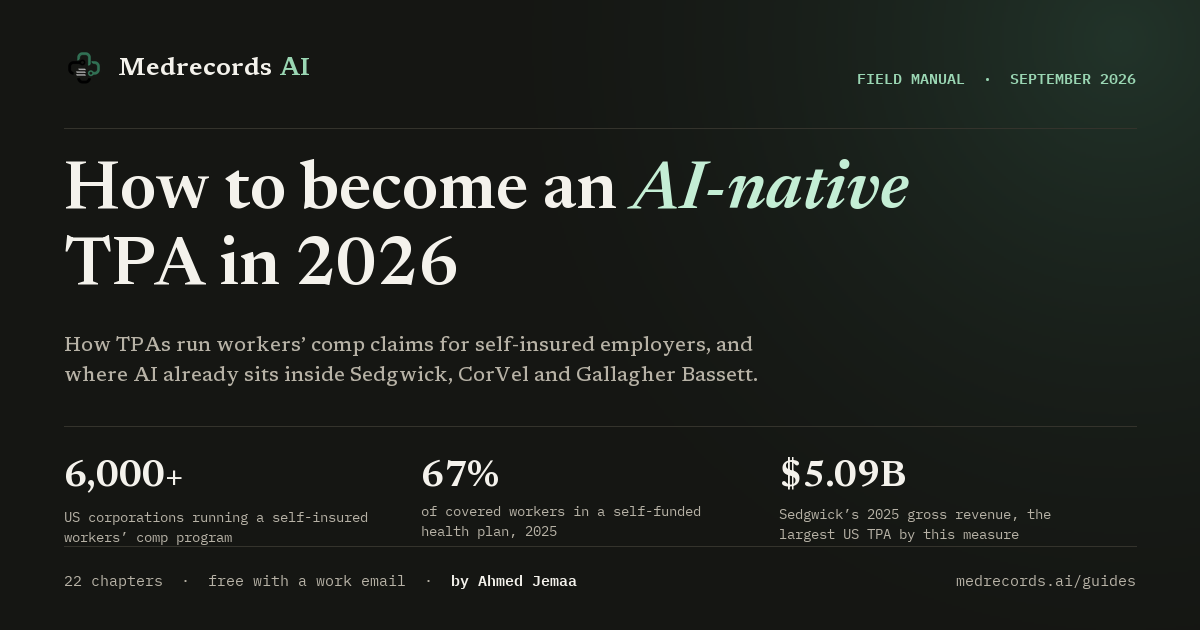
The workflow, the tools and the review steps for a TPA who wants AI to do the page-turning and keep the judgment human.
Read the free guide →What actually separates these tools
4 properties decide this purchase, and not one of them is the model.
Where an underwriting file differs from a claims file
The record looks the same. The question asked of it does not, and that changes which published property is worth paying for.
The ranking at a glance
| Rank | Tool | Best for | Pricing | Processing model |
|---|---|---|---|---|
| #1 | Medrecords AIThis is us | Reading the APS packet you already hold, with page citations | from 10¢ to as low as 5¢ a page on Self-Service… | AI drafts and cites; you review and sign |
| #2 | Clareto | Consolidating several sources into one underwriting file | Successor product claims ~50% average per-record savings… | Not published |
| #3 | MIB Group | Cross-checking an applicant against the industry exchange | Not published | Automated Data Aggregation |
| #4 | RGA (AURA Next) | Point-of-sale, straight-through underwriting decisions | Not published | AI + Workflow Automation |
| #5 | Munich Re Automation Solutions (ALLFINANZ) | A rules engine carriers configure themselves | Subscription/SaaS (ALLFINANZ SPARK) | AI + Workflow Automation |
| #6 | Milliman IntelliScript | Pharmacy and clinical data as structured risk signals | Not published | Automated Data Aggregation |
| #7 | Human API / LexisNexis Health Intelligence | EHR summaries with APS ordering attached | Not published | AI + Workflow Automation |
| #8 | Verisk Life Solutions (EHR Triage Engine Plus) | Triaging an EHR file into a risk summary | Not published | AI + Workflow Automation (NLP-based EHR triage) |
| #9 | iPipeline | Straight-through processing across the wider policy workflow | Not published | AI + Workflow Automation |
| #10 | ExamOne | Collecting applicant health data at source | Not published | Not published |
| #11 | EMSI (Examination Management Services, Inc.) | Underwriting exam services, with almost nothing published | Not published | Not published |
| #12 | Sixfold | Property & Casualty and Life & Health insurance underwriting teams | Contracted/Volume-based (enterprise, by submission volume) | 100% AI (underwriting document analysis and risk scoring) |
| #13 | Klaimy | Health/life insurers, reinsurers & brokers - medical document | Subscription (flat fee + usage-based, volume discounts) | AI-Powered Medical Data Extraction & Underwriting/Claims… |
| #14 | Stream Claims | Large enterprise carriers - structuring and auditing claim documents | Not published | AI + Human Expert-Led ("Your Experts Lead… |
| #15 | InQuery | High-severity, multi-source claims needing rapid fact extraction | Not published | AI + Human QA |
Every row links to the full entry below. "Not published" means the vendor does not publish a figure; we do not estimate.
See your own file as a cited chronology.
First case is free on us, after a demo. Each line links to the page it came from.
Book a demoHow these are ranked
None of these vendors publishes accuracy data for underwriting files specifically, and this page does not pretend otherwise. What changes with the segment is which of their published properties matters most on that kind of file. That is what the order below argues.
Medrecords AI
Best for Reading the APS packet you already hold, with page citationsReads every format plus the actual DICOM study, links every chronology line back to its source page, and publishes a per-page rate.
Pros
- Every chronology line links back to its exact source page, so you verify instead of trusting
- Reads the DICOM study itself, not only the radiologist’s 1-page report
- Duplicates removed and wrong-patient pages quarantined before they reach the summary
- Dictate or upload your exam findings and the report drafts itself from the findings and the record, every statement cited
Cons
- Does not retrieve records from providers — you bring the file you hold
- Keeps a qualified human as the decision-maker by design, so it will not render an opinion for you
Clareto
Best for Consolidating several sources into one underwriting fileConsolidates records from several sources into one underwriting file. Its published turnaround, savings and export facts belong to the successor MIB product rather than to Clareto as sold.
Pros
- Human-prepared EHR summaries in the successor product
- Successor product states the majority of records release in under a day
- 4 export formats published: PDF, HTML, XML and JSON
Cons
- The published turnaround, cost and export facts are the successor product’s, not Clareto’s
- No public reviews found at capture
MIB Group
Best for Cross-checking an applicant against the industry exchangeAn industry information exchange rather than a record reader: it cross-checks an applicant against what other carriers have already seen.
Pros
- Cross-checks an applicant against the industry exchange, which no record reader can do
- Publishes a stated 2 to 4 day waiting period before EHR consolidation
Cons
- Aggregates data rather than reading a record and citing it
- No price published
- No human QA disclosed
RGA (AURA Next)
Best for Point-of-sale, straight-through underwriting decisionsAn automated underwriting decision engine aimed at point-of-sale issue, with a case study citing weeks reduced to minutes.
Pros
- Built for straight-through, point-of-sale underwriting
- Case study cites weeks reduced to minutes
Cons
- Decides risk rather than reading a record and citing it
- No price published
- No human QA disclosed
Munich Re Automation Solutions (ALLFINANZ)
Best for A rules engine carriers configure themselvesA rules-engine underwriting platform sold as a SaaS subscription, aimed at mid-tier and large life and health carriers.
Pros
- Publishes a subscription pricing model rather than quote-only
- Rules engine the carrier configures against its own underwriting manual
Cons
- Publishes the pricing model but no rate
- No turnaround published
- No human QA disclosed
Milliman IntelliScript
Best for Pharmacy and clinical data as structured risk signalsPulls pharmacy, EHR and medical data as structured risk signals for mortality and morbidity assessment.
Pros
- Pharmacy data alongside EHR, which an APS packet often does not contain
- Aimed squarely at mortality and morbidity risk assessment
Cons
- Publishes 4 of the 8 facts a buyer needs: no price, no turnaround
- Produces structured signals rather than a readable, cited record
- No human QA disclosed
Human API / LexisNexis Health Intelligence
Best for EHR summaries with APS ordering attachedSummarises the EHR and orders the APS automatically, so retrieval and summarisation sit inside one workflow.
Pros
- APS ordering and EHR summarisation in the same workflow
- Aimed at readable summaries rather than raw data feeds
Cons
- No price published
- No turnaround published
- No human QA disclosed
Verisk Life Solutions (EHR Triage Engine Plus)
Best for Triaging an EHR file into a risk summaryNLP triage that turns an EHR file into a risk summary for the underwriter rather than a full readable chronology.
Pros
- Triage-first design, which suits a queue of applications rather than one deep file
- Aimed at underwriting risk summaries specifically
Cons
- No price published
- No turnaround published
- No human QA disclosed
iPipeline
Best for Straight-through processing across the wider policy workflowA rules engine with predictive analytics, sold as part of a wider policy workflow rather than as a record reader.
Pros
- Covers the wider policy workflow, not only the medical evidence
- Rules engine and predictive analytics on one platform
Cons
- Publishes 4 of the 8 facts a buyer needs
- No price published
- No turnaround published
ExamOne
Best for Collecting applicant health data at sourceA paramedical exam network: it collects the applicant health data that the other tools on this page then read.
Pros
- Collects applicant health data at source, which software cannot do
Cons
- Publishes 2 of the 8 facts a buyer needs: no price, no turnaround, no processing model
- Collection rather than review, so nothing here reads or cites a record
EMSI (Examination Management Services, Inc.)
Best for Underwriting exam services, with almost nothing publishedAn underwriting exam-services vendor whose Content Hub profile carries one published fact out of 8.
Pros
- Sits in the underwriting supply chain, so it competes with exam networks rather than with record readers
Cons
- Publishes one of the 8 facts a buyer needs: nothing on price, turnaround, processing model or exports
- Nothing to check a quote against before the call
Sixfold
Best for Property & Casualty and Life & Health insurance underwriting teamsAI underwriting platform for P&C and Life & Health insurers; for life insurance specifically, it 'distills APS [attending physician statements]…
Pros
- Processing model: 100% AI (underwriting document analysis and risk scoring)
- Built for: Property & Casualty and Life & Health insurance underwriting teams
Cons
- Indicative cost is not published; you need a quote
- Turnaround is not published
- No human quality-check step is described in its published materials
Klaimy
Best for Health/life insurers, reinsurers & brokers - medical document processing (France)Klaimy does not publish a service description in the sources this profile cites. The fields below record only what could be confirmed from the 4 public sources cited at the foot of this page…
Pros
- States a turnaround: Under 5 seconds per document (per customer testimonials, no official SLA)
- Export formats stated: API integration with existing claims/underwriting systems
- Built for: Health/life insurers, reinsurers & brokers - medical document processing (France)
Cons
- Indicative cost is not published; you need a quote
- No human quality-check step is described in its published materials
Stream Claims
Best for Large enterprise carriers - structuring and auditing claim documents (medical records, demand packages)Stream Claims does not publish a description of its services. The fields below record only what could be confirmed from the 2 public sources cited at the foot of this page…
Pros
- Human quality check: Included (outputs generated for human expert review)
- Export formats stated: API and batch SFTP integration
- Built for: Large enterprise carriers - structuring and auditing claim documents (medical records…
Cons
- Indicative cost is not published; you need a quote
- Turnaround is not published
InQuery
Best for High-severity, multi-source claims needing rapid fact extractionInQuery does not publish a description of its services. The fields below record only what could be confirmed from the 17 public sources cited at the foot of this page…
Pros
- States a turnaround: 2-6 hours (standard 300-500 page PI case)
- Human quality check: Included ('People check the work')
- Built for: High-severity, multi-source claims needing rapid fact extraction
Cons
- Indicative cost is not published; you need a quote
- Export formats are not published
Watch a question come back with its sources.
Medrecords AI is the pick when an APS packet is already in your hands and you want it deduplicated, dated and cited before an underwriter reads it. It is not the pick for ordering records from providers, for pulling a pharmacy history, or for scoring mortality risk. Nothing on this page should be allowed to decide whether a policy issues. That decision belongs to an underwriter, on a record they can check.
The same question, asked by a different buyer
Underwriting is one of 4 segments where the record arrives in bulk and someone has to answer for what is in it. The cohort overlaps; the property that decides the purchase does not.
What to confirm before you buy
Side-by-side: price, model, turnaround and quality check
| Option | Price or rate | Processing model | Turnaround | Human QA |
|---|---|---|---|---|
| Medrecords AI | 10¢ to as low as 5¢/page, duplicates free | AI drafts and cites; you review and sign | About 100 pages/min | You review and sign |
| Clareto | Successor product claims ~50% average per-record savings vs… | Not published | Successor product states majority of records released in… | Included (successor MIB "RiskRighter" offers human-prepared… |
| MIB Group | Not published | Automated Data Aggregation (industry information exchange) | 2-4 Day Flexible Waiting Period before EHR consolidation | Not published |
| RGA (AURA Next) | Not published | AI + Workflow Automation (automated underwriting decisioning) | Weeks reduced to Minutes (per case study) | Not published |
| Munich Re Automation Solutions (ALLFINANZ) | Subscription/SaaS (ALLFINANZ SPARK) | AI + Workflow Automation (rules-engine underwriting platform) | Not published | Not published |
| Milliman IntelliScript | Not published | Automated Data Aggregation (pharmacy, EHR and medical data) | Not published | Not published |
| Human API / LexisNexis Health Intelligence | Not published | AI + Workflow Automation (EHR summarization + auto APS ordering) | Not published | Not published |
| Verisk Life Solutions (EHR Triage Engine Plus) | Not published | AI + Workflow Automation (NLP-based EHR triage) | Not published | Not published |
| iPipeline | Not published | AI + Workflow Automation (rules engine, predictive analytics) | Not published | Not published |
| ExamOne | Not published | Not published | Not published | Not published |
| EMSI (Examination Management Services, Inc.) | Not published | Not published | Not published | Not published |
| Sixfold | Contracted/Volume-based (enterprise, by submission volume) | 100% AI (underwriting document analysis and risk scoring) | Not published | Not published |
| Klaimy | Subscription (flat fee + usage-based, volume discounts) | AI-Powered Medical Data Extraction & Underwriting/Claims Automation | Under 5 seconds per document (per customer testimonials… | Not published |
| Stream Claims | Not published | AI + Human Expert-Led ("Your Experts Lead. Stream Delivers.") | Not published | Included (outputs generated for human expert review) |
| InQuery | Not published | AI + Human QA | 2-6 hours (standard 300-500 page PI case) | Included ('People check the work') |
Figures are what each vendor publishes about itself. "Not published" means we found no figure; we do not estimate.
Which option fits your use case
| If you need | Start with |
|---|---|
| Reading the APS packet you already hold, with page citations | Medrecords AI |
| Consolidating several sources into one underwriting file | Clareto |
| Cross-checking an applicant against the industry exchange | MIB Group |
| Point-of-sale, straight-through underwriting decisions | RGA (AURA Next) |
| A rules engine carriers configure themselves | Munich Re Automation Solutions (ALLFINANZ) |
| Pharmacy and clinical data as structured risk signals | Milliman IntelliScript |
| EHR summaries with APS ordering attached | Human API / LexisNexis Health Intelligence |
| Triaging an EHR file into a risk summary | Verisk Life Solutions (EHR Triage Engine Plus) |
| Property & Casualty and Life & Health insurance underwriting teams | Sixfold |
| Health/life insurers, reinsurers & brokers - medical document | Klaimy |
| Large enterprise carriers - structuring and auditing claim documents | Stream Claims |
| High-severity, multi-source claims needing rapid fact extraction | InQuery |
What users of Medrecords AI say
“It's so refreshing (to pay per use instead of a year-long contract)... pretty game-changing.”
Timothy, expert witness consultant“Even an hour (to process a full case file) is super fast. I was worried it might take 2 or 3 days.”
Brian, IME physicianBest AI tools for life insurance underwriting: common questions
What is the best AI tool for life insurance underwriting?
It depends which half of the job you are buying. For reading an APS packet that has already arrived and citing every line back to its source page, Medrecords AI is the pick, and it publishes a per-page rate. For ordering the records, pulling pharmacy history or scoring mortality risk, the specialist underwriting vendors on this page do work that a record reader does not attempt.
Can AI decide whether a policy should issue?
Several platforms on this page automate underwriting decisions against rules the carrier configures, and they publish that. That is a different thing from a model forming a judgment. Whatever the workflow, the decision and the accountability for it sit with the carrier, and the record it rested on has to still be readable when someone asks about it later.
What is an APS summary, and how does it differ from a medical chronology?
An APS summary answers an underwriting question: what does this history predict. A medical chronology answers a litigation question: what happened, when, and on which page. The underlying work is the same reading, sorting and deduplication. The output differs in what it foregrounds, which is why some vendors sell one and some sell the other.
Do any of these vendors publish accuracy figures for underwriting files?
No. Not one of the 11 publishes an accuracy figure specific to APS or EHR underwriting review, and this page does not manufacture one. What can be compared is what each vendor does publish: the processing model, whether a human reviews the output, turnaround, price and export formats. Across the 10 vendors besides Medrecords AI, an average of 4 of those 8 fields carry a published value.
How much does AI-assisted APS review cost?
Most of this cohort publishes nothing. Medrecords AI publishes a per-page rate on self-service with duplicates not charged. Munich Re Automation Solutions publishes a subscription model without a rate, and Clareto’s successor product claims roughly half the per-record cost of traditional APS retrieval. Every other price on this page starts with a call.
Why are exam networks on a list of AI tools?
Because they sit in the same buying conversation and are routinely compared against software, which is exactly the mistake worth avoiding. ExamOne and EMSI collect applicant health data at source. Nothing they publish suggests they read or cite an existing record. They are on the page so the distinction is visible rather than discovered in a demo.
How did we choose the AI tools for life insurance underwriting on this list?
We included vendors in our Content Hub whose published materials describe this task, then compared them on 6 criteria: published pricing, processing model, source traceability, turnaround, security posture and fit to the task. We have not run the same records through every tool, so the order is editorial judgment, not a test score.
How many of these options publish their pricing?
2 of 15 publish at least 1 price or rate, including Medrecords AI, Clareto. The rest require a quote, and this page marks those "Not published".
Which of these options keep a human in the loop?
2 of 15 describe a human or hybrid step in their own materials, including Stream Claims, InQuery. Medrecords AI keeps a qualified person as the final decision-maker by design: the tool drafts and cites, and you review and sign.
Start with 1 case
Your records stay yours. The first case is free on us, after a demo. We process about 100 pages a minute. Every output line links to its source page. Read the free guide first if you want the workflow. Or book a short demo and run your own file.
Send one APS packet through it
Upload a file you already hold and see the deduplicated, dated, page-cited version before you decide anything.
Book a demoSources
Every figure above about another vendor is what that vendor publishes about itself, read on the date shown. Where a vendor does not publish a figure, this page says so rather than estimating it. Vendor links open the vendor's own page.
- Clareto — clareto.com site, read 26 Sep 2026
- EMSI (Examination Management Services, Inc.) — emsinet.com site, read 14 Sep 2026
- ExamOne — examone.com site, read 14 Sep 2026
- Human API / LexisNexis Health Intelligence — risk.lexisnexis.com site, read 10 Sep 2026
- InQuery — inquery.ai site, read 14 Sep 2026
- iPipeline — ipipeline.com site, read 14 Sep 2026
- Klaimy — klaimy.fr site, read 14 Sep 2026
- MIB Group — mibgroup.com site, read 14 Sep 2026
- Milliman IntelliScript — rxhistories.com site, read 14 Sep 2026
- Munich Re Automation Solutions (ALLFINANZ) — automation-solutions.munichre.com site, read 14 Sep 2026
- RGA (AURA Next) — rgare.com site, read 14 Sep 2026
- Sixfold — sixfold.ai site, read 14 Sep 2026
- Stream Claims — stream.claims site, read 14 Sep 2026
- Verisk Life Solutions (EHR Triage Engine Plus) — verisk.com site, read 14 Sep 2026